



Vol.52. August 31. 2026
What is happening in East Asian Maritime Security? The Research Institute for Peace and Security (RIPS) publishes the biweekly newsletter, the information on maritime security relevant to East Asia and Japan's territory.
Monthly Column
Could Divided-State Status Support Japan’s Direct Defense of Taiwan?
by Prof. Masahiro Kurosaki
Professor of International Law, Tohoku University School of Law, Japan
Introduction
Whether Japan could lawfully join in the defense of Taiwan is a question that has drawn renewed attention. In November 2025, Prime Minister Sanae Takaichi told the Diet that a Taiwan contingency involving warships and the use of force could, in her words, “by any reckoning,” amount to a “survival-threatening situation” (sonritsu kiki jitai)—the trigger under the 2015 peace and security legislation for Japan’s limited exercise of the right of collective self-defense.[i] The statutory formula requires “an armed attack against a foreign country that is in a close relationship with Japan” which in turn threatens Japan’s survival. Two different legal questions hide inside that one formula, depending on which foreign country is attacked. If it is the United States—whose forces might intervene in a Taiwan contingency and come under Chinese fire—the statehood question presents no special difficulty; the United States is unquestionably a State, though whether Japan would act remains a separate political judgment. If the victim is Taiwan itself, the analysis changes. The International Court of Justice’s 1986 Nicaragua judgment confirmed that collective self-defense is a right exercised for the benefit of a victim State, one that must itself declare that it has been attacked and request assistance.[ii] Taiwan’s own statehood is precisely what is in doubt. This essay is about that harder question—not whether Japan can defend American forces coming to Taiwan’s aid, but whether Japan can defend Taiwan directly.
Taiwan, as matters stand, cannot readily be evaluated as a State. Effectiveness is not seriously in question within the area Taiwan actually governs; it has a population of some twenty-three million, a defined territory—Taiwan, Penghu, Kinmen, and Matsu—under its unbroken control since 1955, and a government of undoubted capacity. The difficulty, as I have argued elsewhere,[iii] lies instead in the mismatch between that effective control and the Republic of China’s own official claim, which nominally still extends to the Chinese mainland. Taiwan’s constitutional order remains that of the Republic of China. The Additional Articles, in force since 1991, are framed “to meet the requisites of the Nation prior to national unification” and confine themselves to regulating relations between a “free area” and a “mainland area,” without redefining the Republic’s territory as Taiwan alone. Individual leaders have gone further politically than legally—Lee Teng-hui called cross-strait relations a “special state-to-state relationship” in 1999, Chen Shui-bian called Taiwan and China “one country on each side” in 2002, Lai Ching-te insisted in 2025 that Taiwan is “of course” a country. Lee’s and Chen’s statements were each met within days by an official clarification that they changed nothing; Lai’s does not appear to have been withdrawn, but neither has it been entrenched in any constitutional or legislative act. And the closest occasion on which voters were asked to endorse an international-status claim under the name “Taiwan,” a 2008 referendum on U.N. membership, carried 94 percent of the vote cast but failed Taiwan’s own fifty percent turnout requirement and had no legal effect—although abstention does not necessarily imply opposition, and the question itself fell short of a vote on independence. Because recognition is declaratory rather than constitutive, other States’ treatment of Taiwan is relevant evidence but not dispositive. What also matters here is whether Taiwan’s own competent organs have settled on an unequivocal claim reflecting the will of its people and the status quo. On the constitutional record, for now, they have not.
If Taiwan is not a State, a Japanese use of force in its direct defense cannot straightforwardly be justified as collective self-defense in the ordinary Article 51 sense.
Yet the Japanese government has itself suggested an opening in its own doctrine. During the 2015 Diet deliberations, then-Foreign Minister Fumio Kishida was asked whether the existence of diplomatic relations was relevant to identifying a “foreign country in a close relationship,” and answered that since the right of self-defense is exercised by States, the country concerned must be a State—but that, as the government had traditionally explained, “unrecognized states” (mishōnin-koku) and “divided states” (bunretsu kokka) are included.[iv] This was a general proposition, not a claim about Taiwan specifically. Pressed directly on whether Taiwan qualified, Kishida declined to answer, citing Japan’s renunciation of all right, title, and claim to Taiwan under the San Francisco Peace Treaty.[v] If sound, that proposition points to the one route by which Japan might still defend Taiwan directly without conventional statehood: showing both that Taiwan qualifies as a “divided state” and that divided-state status carries some protection under the law on the use of force. Yet neither half of that claim survives testing comfortably.
[i] Statement of Prime Minister Sanae Takaichi, House of Representatives, Budget Committee, Nov. 7, 2025.
[ii] Military and Paramilitary Activities in and against Nicaragua (Nicaragua v. United States of America), Merits, Judgment, I.C.J. Reports 1986, p. 14, paras. 195, 199.
[iii] Masahiro Kurosaki, “Reformulating Taiwan’s Statehood Claim,” Lawfare, https://www.lawfaremedia.org/article/reformulating-taiwan-s-statehood-claim.
[iv] Statement of Foreign Minister Fumio Kishida, House of Representatives, Special Committee on the Peace and Security Legislation, June 15, 2015.
[v] Kishida, House of Representatives, Special Committee on the Peace and Security Legislation, June 15, 2015.
I. The Diet Formula and Its Cold War Origins
Kishida described the inclusion of unrecognized and divided states as something the government had “traditionally explained.” The “close relationship” concept is a product of that same 2015 legislation, so the exact phrase has no earlier history; the term “divided state” does not share that limitation. What the record does disclose is the doctrine’s substance. During the Vietnam War, the Foreign Ministry’s treaty bureau chief told the Diet that crossing an internationally established line partitioning a divided state would amount to aggression and, in the same breath, to an armed attack, against which the attacked side would naturally hold a right of self-defense—a principle, he added, already settled beyond doubt since the Korean War.[ⅵ] The paradigm is North Korea; never recognized by Japan as an independent State, yet—a United Nations member since 1991—a State capable of committing an armed attack within the meaning of Article 51.
What this history shows is limited: the absence of Japanese recognition or diplomatic relations does not remove an entity from the class of States for the use of force. But that understanding formed in a world where both halves of every divided nation had come to satisfy the criteria of statehood. Whether the formula can do any work for an entity that has not—Taiwan’s situation—depends on what “divided state” actually means, and why it was ever thought to matter for the use of force.
[ⅵ] Statement of Banri Fujisaki, Director-General of the Treaty Bureau, Ministry of Foreign Affairs, House of Representatives, Budget Committee, July 18, 1966.
II. What Is a “Divided State,” and Could Taiwan Be One?
The term is descriptive before it is legal. It entered the vocabulary after the Second World War to capture the parallel predicaments of Germany, Korea, Vietnam, and China: single nations within which rival authorities emerged, each claiming to be the sole legitimate government of the whole. A divided state, by the standard definition, exists where the partitioning line cannot be regarded as a frontier in the legal sense.[ⅶ] Yet the prevailing doctrinal verdict is deflationary: there is no separate juridical category of the “divided state.” Whether the components of a divided nation constitute parts of a single State or two States “depends on general criteria for statehood—not on some postulated category of ‘divided States’ into which a variety of cases are supposed to fit.”[ⅷ] The case histories of Germany, Korea, and Vietnam bear this out. In each case, crucially, both halves could be characterized as independent States by ordinary criteria—before self-determination had crystallized as a cardinal principle, when a people’s own claim to separate statehood was not itself decisive—notwithstanding each side’s own un-renounced claim to the whole nation. This is why Crawford calls the “divided state” label legally idle; it added nothing that statehood criteria did not already supply.
Taiwan’s situation, on the analysis above, is harder to assimilate to the classic cases. Although it satisfies the effectiveness criteria, it has not unequivocally claimed separate statehood within the territory it actually governs—itself a requirement of contemporary self-determination doctrine, not of any recognition-based theory. Whether Taiwan can even be called a divided state is itself disputed, and scholars divide on the question. A further, structural difference reinforces the point: the Taiwan Strait has been stabilized since the mid-1950s by deterrence and geography, not by an agreed demarcation line—its median line was drawn unilaterally by the United States in 1955, and Beijing has never accepted it as binding. Further, there has been no mutual accommodation of the sort that matured the German and Korean divisions into settled fact—no equivalent of the Basic Treaty, no simultaneous U.N. admission. Under the loose, traditional understanding grouping these four cases together, Taiwan can plausibly be counted among them; under any more demanding test, it cannot confidently be. That looser label carries no legal significance here. What matters is the one feature Taiwan lacks—an internationally established boundary—on which the use-of-force theory examined next depends.
[ⅶ] James Crawford, The Creation of States in International Law (2nd ed., Oxford: Oxford University Press, 2006), p. 450.
[ⅷ] Crawford, The Creation of States, p. 451.
III. Why Might Divided-State Status Matter for the Use of Force? The Korean Precedent
The clue lies in Korea in 1950, not in any definition of “divided state.” When North Korean forces crossed the 38th parallel on June 25, 1950, the U.N. Security Council did not pause to resolve whether the Democratic People’s Republic of Korea was a State, or whether the Republic of Korea was, or whether the parallel was an international boundary in the strict sense—all genuinely unsettled at that date. Noting “with grave concern the armed attack on the Republic of Korea by forces from North Korea,” U.N. Security Council Resolution 82 determined that this action “constitutes a breach of the peace”—not quite “aggression” in the Charter’s terms. Two days later, U.N. Security Council Resolution 83 recommended that member States “furnish such assistance to the Republic of Korea as may be necessary to repel the armed attack and to restore international peace and security in the area” (italics added in both quotations). Twenty years later, the General Assembly’s Friendly Relations Declaration articulated a broader principle to similar effect: every State must refrain from the threat or use of force “to violate international lines of demarcation, such as armistice lines, established by or pursuant to an international agreement to which it is a party or which it is otherwise bound to respect,” even where the line falls short of a full international frontier. An inter-State boundary is one limit on the use of force, Crawford notes, “but, as resolution 2625 (XXV) recognizes, there can be other such boundaries.”[ⅸ]
Put together, Korea 1950 and the Friendly Relations Declaration suggest a theory: that crossing an established demarcation line separating the two halves of a divided nation can itself be an unlawful use of force of the gravity the ICJ’s Nicaragua judgment later required for an armed attack—one of “the most grave forms of the use of force”—against which the attacked side, and those coming to its aid, might in principle act in self-defense, without first resolving every question about the attacked side’s formal statehood. On that theory, Japan’s collective self-defense would rest not on Taiwan’s statehood but on the protected status of the line and the armed attack its crossing would constitute. Whether that also supplies the victim-State standing Article 51 requires is the difficulty addressed next.
[ⅸ] Crawford, The Creation of States, p. 450.
IV. Why the Theory Is Too Fragile to Rely On
Attractive as it is, the theory is not itself the holding of any single authority: it is an inference drawn by combining two sources, neither of which, on its own terms, supplies it. Korea 1950 shows that the Security Council can recommend collective assistance to a divided state’s half without resolving its statehood—but the Council did not invoke Article 51 in doing so, only language the United Nations’ own repertory of practice describes as merely having “some bearing on” it.[ⅹ] The Friendly Relations Declaration’s demarcation-line principle, for its part, obliges States not to use force against protected lines but says nothing about who may invoke Article 51 self-defense in response to a violation, and in any event confines the protected lines to those established by an agreement binding the State concerned—a description the Taiwan Strait, as noted above, does not meet. Vietnam shows why that last condition is no formality—and shows it using the very line Japan’s own Foreign Ministry cited in 1966 as the doctrine’s guiding example: the 1954 Geneva Final Declaration provided that the 17th parallel “should not… be interpreted as constituting a political or territorial boundary,” yet the United States invoked collective self-defense under Article 51 to defend South Vietnam against forces crossing it—a controversial claim made independently of Security Council collective-security action. The Taiwan Strait, lacking even Vietnam’s degree of formal agreement, meets the Friendly Relations Declaration’s condition even less.
On the current record, neither route is available: Taiwan has made no independent and unequivocal claim to statehood, and, as just shown, the divided-state theory does not reach the Taiwan Strait either. It is accordingly difficult to identify a solid legal basis on which Japan could defend Taiwan directly, as distinct from defending American forces that come to its aid.
[ⅹ] United Nations, Repertory of Practice of United Nations Organs, vol. 2 (1945–1954), Article 51, p. 430 n. 5, https://legal.un.org/repertory/art51/english/rep_orig_vol2_art51.pdf.
Conclusion
Rightly understood, the divided state is not a shortcut to Japan’s direct defense of Taiwan; tracing its logic to the source shows how much still depends on the requirement of statehood. Japan’s Diet formula—that unrecognized and divided states may be objects of collective self-defense—was offered as a general proposition, and this essay has found no reason to think it wrong. The possibility of a lawful Japanese defense of a divided-state Taiwan is not zero, and the theory could, in principle, be extended to Taiwan’s case. All that said, that theory asks more of its foundations than they supply: the Friendly Relations Declaration’s principle does not extend to the Taiwan Strait, where no relevant line has been established by or pursuant to an international agreement binding the PRC. Taiwan’s possible status as a divided state cannot, on the current state of international law, by itself supply a sufficiently secure legal basis for direct Japanese defense of Taiwan. Short of an independent and unequivocal Taiwanese claim to statehood, then, Japan’s soundest route to involvement in a Taiwan contingency remains the indirect one: defending American forces that come to Taiwan’s assistance, rather than defending Taiwan directly on the divided-state theory examined here. That indirect route, however, necessarily assumes that the United States’ intervention is lawful and that an attack on its forces constitutes an armed attack giving rise to its own right of self-defense.
Views expressed or implied in this article are solely those of the author. They must not be construed as representing the views and positions of RIPS or any other organizations.
Statistical Data and Analysis (as of August 31)
China is routinely making maritime intrusions into Japanese territorial waters and conducting unauthorized research within its EEZ. It has also encroached upon waters around Taiwan’s Pratas Islands while advancing development in the Paracels. To pressure the Philippines, China gathered as many as 200 fishing boats at Mischief Reef and conducted live-fire exercises in the northern South China Sea.
Amidst the protracted conflict with Iran, the U.S. has paused aircraft carrier deployments in the Pacific, likely expanding China’s Western Pacific presence. President Trump’s directives to alter carrier designs have sparked fears of future vessel shortages, intensifying concerns over a relative decline in U.S. presence.
To address this situation, Asian countries are seeking to strengthen their defense capabilities. They are substantially increasing defense budgets. Taiwan conducted realistic drills during its annual Han Kuang exercises to boost contingency response capabilities. Japan’s defense minister, meeting with his Australian and Indian counterparts, pledged to strengthen security cooperation, while Australia is enhancing maritime security with intelligence-gathering operations in the South China Sea.
[Statistical Data as of August 31]
The Japan Coast Guard (JCG) daily updates the statistical data on the number of China Coast Guard vessels entering in the contiguous zone around the Senkaku Islands and intruding into Japanese territorial waters. The below is from the website of the JCG.
https://www.kaiho.mlit.go.jp/mission/senkaku/senkaku.html
| Aug. | Contiguous zone |
Territorial sea |
Aug. | Contiguous zone |
Territorial sea |
|
|---|---|---|---|---|---|---|
| 14 | 4 | 4 | 23 | 4 | ||
| 15 | 4 | 24 | 4 | |||
| 16 | 4 | 25 | 4 | |||
| 17 | 4 | 26 | 2 | |||
| 18 | 4 | 27 | 2 | |||
| 19 | 4 | 28 | 2 | |||
| 20 | 3 | 29 | 4 | |||
| 21 | 4 | 30 | 4 | |||
| 22 | 4 | 31 |
Topics
| Date | Topics |
|---|---|
| 8/13 |
Taiwan announced in July that it had detected “abnormal” cyberattacks against government agencies. Experts stated that open-source AI agents are being used to build autonomous hacking tools. Although Taiwan did not suggest China’s involvement in these attacks, experts noted that China's involvement is somewhat likely. The Gurdianhttps://www.theguardian.com/technology/2026/aug/13/taiwan-ai-assisted-cyber-attacks-overseas |
| 8/13 |
The US Under Secretary of War was once skeptical of AUKUS and perceived as reluctant to provide nuclear-powered submarines. However, following the President's positive stance toward the pact, he shifted to a proactive approach. He stated that the United States has no better ally than Australia, adding that the two nations are aligned in their thinking. The Gurdianhttps://www.theguardian.com/world/2026/aug/13/pentagon-official-and-former-aukus-sceptic-says-deal-is-full-steam-ahead-echoing-trump |
| 8/13 |
China has been conducting marine surveys in waters that include Japan’s exclusive economic zone (EEZ), aiming to secure rare earth elements discovered around Minamitorishima Island. Under these circumstances, U.S. cooperation has become increasingly vital for Japan. To break free from its dependence on China for rare earth elements, developing the resources around Minamitorishima is crucial. The Japan Timeshttps://www.japantimes.co.jp/news/2026/08/13/japan/us-japan-undersea-mine-china/ |
| 8/14 |
On August 13, the JMSDF confirmed one Russian one Improved Kilo class submarine and one Igor Belousov class submarine rescue ship sailing northeast in waters 80km south of Yonagunijima Island (Okinawa Prefecture). These vessels sailed northeast through waters between Yonagunijima Island and Iriomotejima Island (Okinawa Prefecture) and navigated to the East China Sea. 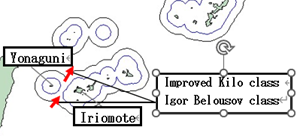 https://www.mod.go.jp/js/pdf/2026/p20260814_04.pdf |
| 8/14 |
On August 14, the JMSDF confirmed four Russian Tarantul-III class corvettes (hull number 916, 946, 971 and 978) sailing west in waters 40km northeast of Cape Soya (Hokkaido Prefecture). These vessels sailed west through the Soya Strait. 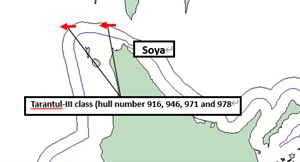 https://www.mod.go.jp/js/pdf/2026/p20260814_05.pdf |
| 8/14 |
On August 14, according to the JCG, four Chinese government vessels entered Japan’s territorial waters off the Senkaku Islands in the East China Sea. Their hull numbers are 2501, 2304, 2302 and 2303. This was the first confirmed entry of Chinese government ships into the area since July 23. NHK Worldhttps://www3.nhk.or.jp/nhkworld/en/news/20260814_12/ Yaeyama Nippo (Japanese) https://www.yaeyama-nippo.co.jp/article/32835 |
| 8/14 |
The US Ambassador to Japan stated on X that the U.S. remains unwavering in its recognition of Japan’s sovereignty over the Northern Territories, following the Russian President's visit to one of the disputed islands. He also reaffirmed U.S. support for Japan and expressed strong opposition to actions that undermine the peace and stability of the Indo-Pacific. The Northern Territories have been illegally occupied by Russia since the end of World War II. AFP (Barron's)https://www.barrons.com/news/us-backs-japan-over-putin-trip-to-disputed-islands-bba60d57 |
| 8/14 |
On August 14, the annual Han Kuang military exercise concluded. U.S.-style military training methods were adopted in this year’s exercise to enhance Taiwan's coordination and combat readiness. The President of Taiwan participated in the exercise to simulate maintaining government functions under attack. Taiwan’s Navy and Coast Guard conducted their first joint anti-blockade exercise to practice how to escort civilian vessels transporting strategic supplies to Taiwan. APhttps://apnews.com/article/taiwan-han-kuang-military-drills-china-283f26ae2757166fcd3542471f927f00 TBS Cross Dig (Japanese) https://newsdig.tbs.co.jp/articles/withbloomberg/2873830?display=1 Focus Taiwan https://focustaiwan.tw/politics/202608140008 |
| 8/14 |
It has been confirmed that the guided-missile destroyer USS Benfold was without power for four days in the South China Sea in July due to an engine failure. According to a statement from a U.S. 7th Fleet spokesperson, machinery related to the USS Benfold's generators failed on July 24, and the ship was towed by a contracted tugboat to Subic Bay, where it underwent repairs. The repairs were completed by August 7, and the vessel departed Subic Bay on August 8. The Navy is currently investigating the cause of the failure. USNI Newshttps://news.usni.org/2026/08/14/uss-benfold-was-stalled-in-the-south-china-sea-for-four-days-after-engineering-casualty |
| 8/14 |
On August 14, the Taiwan Cabinet's 2026 budget was approved by the Legislative Yuan after a record 266-day delay. The Taiwan Cabinet had submitted the budget bill to the Legislative Yuan on August 31, 2025, but the review of the proposal was delayed by a prolonged political deadlock. The Legislative Yuan reduced the originally proposed budget by NT$48 billion, and expenditures on military equipment and facilities were reduced by 2.5 percent, while the budget for drone procurement and the development of the drone industry was not cut. Focus Taiwanhttps://focustaiwan.tw/politics/202608140026 |
| 8/14 |
Trade between China and Russia via the Northern Sea Route is growing, supporting Moscow's war economy and strengthening Beijing's energy security. Acting as a "near-Arctic state," China is aggressively developing Arctic shipping lanes to establish its "Polar Silk Road," triggering heightened vigilance from Western nations. CNNhttps://edition.cnn.com/2026/08/14/china/china-arctic-northern-sea-route-russia-intl-hnk-vis-dst |
| 8/15 |
The U.S. President has ordered the Navy to revert to steam-powered catapults instead of using the advanced electromagnetic system on future aircraft carriers. Analysts warn that this directive will lead to billions of dollars in extra costs and significantly delay future carrier deployments. CNNhttps://edition.cnn.com/2026/08/14/politics/trump-steam-catapult-navy |
| 8/15 |
On August 15, parliamentary staffers from 12 European countries visited Taiwan under the 2026 European Valued Important Partnership program, which is organized by the Ministry of Foreign Affairs of Taiwan and the Taiwan International Cooperation and Development Fund. The visitors were from Austria, the Czech Republic, France, Germany, Italy, Lithuania, Montenegro, Poland, Portugal, Romania, Slovakia, and the United Kingdom. Taiwan’s Deputy Foreign Minister stressed the importance of closer Taiwan-Europe cooperation amid growing global instability at the reception he hosted. Focus Taiwanhttps://focustaiwan.tw/politics/202608150011 |
| 8/16 |
According to the JCG, a Chinese maritime survey vessel was seen deploying what appeared to be a wire into the water within Japan’s EEZ near the Senkaku Islands on August 15. A JCG patrol vessel demanded that the ship immediately cease its activities, stating that conducting research without the Japanese government’s approval is impermissible. On August 16, a JCG patrol vessel found another Chinese maritime survey vessel doing similar activities in the water west of Kume Island (Okinawa Prefecture) within Japan’s EEZ, and demanded that the Chinese vessel immediately cease its activities. Yomiuri Shimbun online (Japanase)https://www.yomiuri.co.jp/national/20260816-GYT1T00041/ |
| 8/16 |
On August 16, the annual fishing moratorium in the East China Sea, which includes areas around the Senkaku Islands and Taiwan, came to an end, prompting a large number of fishing boats to set sail from ports in Fujian Province. In 2016, hundreds of Chinese vessels gathered around the Senkaku Islands, with some confirmed to have intruded into Japanese territorial waters. In recent years, however, local Chinese government officials have instructed Chinese fishing boats to avoid operating in "sensitive waters." Yomiuri Shimbun online (Japanese)https://www.yomiuri.co.jp/world/20260816-GYT1T00163/ |
| 8/16 |
The USS George Washington is departing the Pacific to relieve the long-deployed USS Abraham Lincoln in the Middle East. This shift comes amid mounting concerns over supply shortages and mental health strain aboard the Lincoln. The USS George Washington's departure leaves the Western Pacific with no U.S. aircraft carrier presence. Analysts warn that this security vacuum provides Beijing with an opportunity to assert its strength in the region. APhttps://apnews.com/article/aircraft-carriers-trump-china-pacific-iran-war-87cfb838de8c13464fa3cab1840ad87d |
| 8/17 |
The U.S. Navy is considering redesigning its future aircraft carriers to accommodate the President's preferences. The Navy is assessing the feasibility of moving the island tower further forward, mimicking World War II-era carriers . Experts noted that such design changes would cost billions of dollars and delay deliveries. On August 13, the President issued a presidential directive requiring future aircraft carriers to adopt steam-powered catapults instead of the advanced electromagnetic system. This move had already drawn criticism for potentially causing billions of dollars in additional expenses and procurement delays. The Washington Posthttps://www.washingtonpost.com/national-security/2026/08/15/navy-weighs-major-warship-redesign-match-trumps-preferences/ |
| 8/17 |
On August 15, JMSDF confirmed one Russian Udaloy-I class (hull number 548) sailing west in the waters 50km northwest of Cape Soya (Hokkaido Prefecture). This vessel sailed west through the Soya Strait. 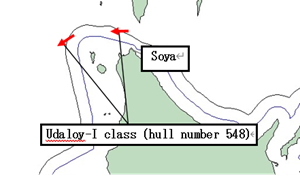 https://www.mod.go.jp/js/pdf/2026/p20260817_02.pdf |
| 8/17 |
On August 15, the JMSDF confirmed one Russian Balzam class intelligence collection ship (hull number 80) sailing northwest in the waters 20km northeast of Cape Soya (Hokkaido Prefecture). This vessel then sailed west through the Soya Strait. 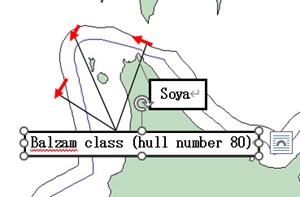 https://www.mod.go.jp/js/pdf/2026/p20260817_03.pdf |
| 8/17 |
On August 16, the JMSDF confirmed one Russian one Improved Kilo class submarine and one Igor Belousov class submarine rescue ship sailing northeast in waters 170km southwest of Tsushima Island (Nagasaki Prefecture). These vessels sailed northeast through the Tsushima Strait and navigated to the Japan Sea. 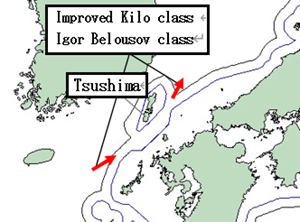 https://www.mod.go.jp/js/pdf/2026/p20260817_04.pdf |
| 8/17 |
The Royal Australian Air Force’s No. 10 Squadron has started its first intelligence collection operation using the MC-55A Peregrine over the South China Sea. The MC-55A is equipped with an AESA radar and possesses advanced intelligence collection capabilities. The Maritime Executivehttps://maritime-executive.com/article/australia-improves-its-surveillance-capability-over-the-south-china-sea |
| 8/18 |
An Armed Forces of the Philippines spokesperson stated that the departure of the USS George Washington from the Western Pacific would not impact planned activities between Philippine and U.S. military units. Describing their naval capabilities as inherently expeditionary, he emphasized that the bilateral defense commitment remains “ironclad.” Philippine News Agencyhttps://www.pna.gov.ph/articles/1282144 |
| 8/18 |
On August 18, the Japan Joint Staff confirmed one Chinese Y-9 intelligence gathering aircraft flying from the continent through the East China Sea toward the area off the coast of the Danjo Islands, Nagasaki Prefecture. The aircraft then proceeded toward the continent. On the same day, the Japan Joint Staff confirmed one Chinese TB-001 reconnaissance/attack UAV flying from the continent through the East China Sea toward the area off the coast of the Danjo Islands, Nagasaki Prefecture. The aircraft flew to off the coast of Okinawa Island, and then proceeded toward the continent. In response, the JASDF scrambled fighter jets. 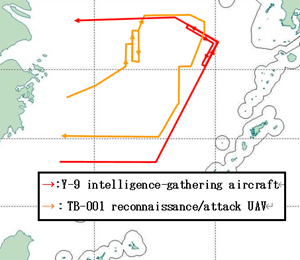 https://www.mod.go.jp/js/pdf/2026/p20260818_02.pdf |
| 8/18 |
On August 18, Japan’s Minister for Foreign Affairs paid a courtesy call on the Chairman of the Presidential Leadership Council of the Republic of Yemen in Riyadh. The minister reaffirmed Japan's commitment to supporting the enhancement of Yemen’s maritime law enforcement capabilities, underscoring its contribution to the realization of the Japan-led “Free and Open Indo-Pacific (FOIP)” vision. The Chairman stated that as a maritime nation, Yemen highly values the FOIP and wishes to deepen bilateral cooperation from this perspective. Ministry of Foreign Affairs of Japanhttps://www.mofa.go.jp/me_a/me2/ye/pageite_000001_01769.html |
| 8/18 |
On August 18, the Japan-Australia Defense Ministers’ Meeting was held in Canberra. Both ministers agreed to deepen trilateral defense cooperation with the U.S. to strengthen deterrence in the Indo-Pacific. The Japanese Defense Minister emphasized that defense cooperation to realize a Free and Open Indo-Pacific is crucial for regional peace and stability. Prior to the talks, the Japanese minister paid a courtesy call on the Prime Minister of Australia to exchange views on defense cooperation. NHK Worldhttps://www3.nhk.or.jp/nhkworld/en/news/20260818_11/ (Reference) Ministry of Defense of Japan https://www.mod.go.jp/en/article/2026/08/3b59625cce400f2b292741059785a188d789bb07.html |
| 8/18 |
Despite Western sanctions, cargo transport on Russia’s Northern Sea Route (NSR) is increasing, driven by expanding trade between Russia and China. In the first half of 2026, bilateral cargo volume via this route exceeded 5 million tons, with both nations targeting an expansion to 20 million tons by 2030. Meanwhile, China is considering utilizing the NSR not just for trade with Russia, but also for commerce with Europe. South Korea is also drawing attention to the route, viewing it as a strategic shipping lane connecting East Asia and Europe. High North Newshttps://en.highnorthnews.com/business/russias-northern-sea-route-cargo-to-surpass-40m-tonnes-as-china-south-korea-dispatch-containerships/1116787 |
| 8/18 |
Diplomatic tensions between Japan and Russia have intensified following the Russian President's visit to the Northern Territories. The president visited one of the islands occupied by the Soviet Union at the end of World War II. While Japan renounced its sovereignty over the Kuril Islands—excluding the Northern Territories—under the 1951 San Francisco Peace Treaty, Russia did not sign the treaty, leaving the dispute between the two nations unresolved. He is only the second Russian leader to visit the islands, following Dmitry Medvedev, who visited previously as either president or prime minister. However, this first-ever visit to the Northern Territories by Vladimir Putin, who has effectively held supreme power since 2000, carries deep political symbolism and is seen as a move that makes any improvement in relations highly difficult. For Russia, the Northern Territories remain critical due to their access to rich fishing grounds, mineral resources, and the Pacific Ocean for its naval fleet. The Gurdianhttps://www.theguardian.com/world/2026/aug/18/kuril-islands-putin-takaichi-dispute-japan-russia-northern-territories |
| 8/19 |
On August 18, Russia’s Foreign Ministry summoned the Japanese ambassador. The Russian Deputy Foreign Minister warned that Moscow maintains “the right to take appropriate countermeasures” against Tokyo, citing Japan's sanctions and its support for Ukraine following the Russian invasion. He also lodged a protest with the Japanese side over what Moscow called "anti-Russian" statements by Japan's Prime Minister and Foreign Minister concerning the Russian President's recent visit to the Northern Territories. The Japanese ambassador appropriately conveyed Japan’s position during the meeting. The Mainichihttps://mainichi.jp/english/articles/20260819/p2g/00m/0in/006000c |
| 8/19 |
The Philippine Foreign Affairs Secretary expressed an optimistic outlook that a Code of Conduct (COC) in the South China Sea would be finalized within the year. Speaking after the 9th Philippine-Malaysia Joint Commission Meeting in Manila, she welcomed the positive progress in the negotiations. She noted that the Philippines and Malaysia share a common perspective on concerns over “illegal and coercive actions” in the South China Sea, without naming specific countries or citing particular incidents. Malaysia serves as a co-chair of the COC negotiations alongside China. Manila Bulletinhttps://mb.com.ph/2026/08/19/philippines-optimistic-south-china-sea-code-of-conduct-talks-will-conclude-in-2026 |
| 8/19 |
On August 19, the third Japan-Saudi Arabia Foreign Ministerial Level Strategic Dialogue was held in Riyadh. The two ministers discussed bilateral and regional cooperation, exchanging views on international and regional affairs including military tensions between the U.S. and Iran, the situation in the Red Sea, and the Palestinian issue. During the dialogue, the Japanese minister expressed Japan’s intention to cooperate with Saudi Arabia, a major regional power, to promote a “Free and Open Indo-Pacific (FOIP),” and his Saudi counterpart welcomed Japan’s engagement. Ministry of Foreign Afffairs of Japanhttps://www.mofa.go.jp/me_a/me2/sa/pageite_000001_01771.html |
| 8/19 |
On August 19, the Japan Joint Staff confirmed one Chinese Y-9 intelligence gathering aircraft flying from the continent through the East China Sea toward the area south of the Danjo Islands, Nagasaki Prefecture. The aircraft flew southwest to the area off the coast of Okinawa Island, then turned back. The aircraft then flew back and forth between the area south of the Danjo Islands and the area off the coast of Okinawa Island before flying to the continent. In response, the JASDF scrambled fighter jets. 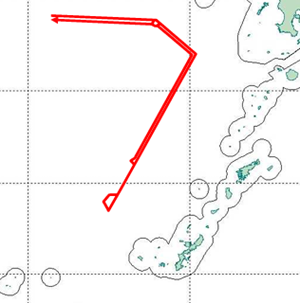 https://www.mod.go.jp/js/pdf/2026/p20260819_02.pdf |
| 8/19 |
On August 18, Taiwan's Coast Guard Administration (CGA) announced that two China Coast Guard vessels entered the restricted waters around the Pratas Islands in the South China Sea. The CGA also stated that it monitored the vessels with patrol boats and drove them away. According to the CGA, this brings the total number of times China Coast Guard vessels have been turned away from the restricted waters around the Pratas Islands this fiscal year to 11 instances involving five vessels. Focus Taiwan (Japanese)https://japan.focustaiwan.tw/cross-strait/202608190005 |
| 8/19 |
The U.S. Pacific Fleet conducted a joint exercise with the Royal Australian Navy in the South China Sea. During this joint exercise, an Australian MH-60R helicopter was operated from the USS George Washington, demonstrating a high level of interoperability between the two militaries. The fact that the U.S. and Australia demonstrated such advanced interoperability in the South China Sea sends a strategic message to China. Army Recognitionhttps://www.armyrecognition.com/news/navy-news/2026/us-australia-carrier-interoperability-sharpens-allied-sea-power-in-the-south-china-sea |
| 8/19 |
n May of this year, Japan and the Philippines officially agreed to initiate negotiations on their maritime boundaries. China immediately condemned the talks, declaring them "illegal, null, and void." Beijing claimed that a significant portion of the waters under negotiation overlaps with areas under Chinese sovereignty. In response, Taiwan maintained that consultations will ultimately be necessary, emphasizing that Taiwanese fishing rights must be protected. Beyond its diplomatic protests, China deployed coast guard and marine research vessels to the contested waters east of Taiwan, executing operations that were deemed at least partially illegal. Determining maritime boundaries through bilateral negotiations aligns with established international practice, and such agreements do not infringe upon the rights of third parties. Consequently, China's maneuvers have been flagged as highly irregular, drawing sharp condemnation from Australia, France, Germany, Taiwan, the United Kingdom, and the United States. These countries worry that China is using the Japan-Philippines talks as an excuse. They fear China wants to tighten its sea blockade around Taiwan and step up "illegal" law enforcement in international waters. Asia Maritime Transparency Initiativehttps://amti.csis.org/as-tokyo-and-manila-talk-boundaries-beijing-breaks-them/ |
| 8/20 |
China has completed the first phase of its artificial island construction project at Antelope Reef in the Paracel Islands. According to satellite imagery, the artificial island spans approximately 6 kilometers in total length and features a straight coastline stretching over 3 kilometers, which experts point out could potentially be used as a runway. Furthermore, the island has a deep-water port, where China Coast Guard vessels have already been spotted docking. Reuters (Taipei Times)https://www.taipeitimes.com/News/front/archives/2026/08/20/200386279 |
| 8/20 |
On August 20, JMSDF confirmed one Russian Slava class cruiser (hull number 011) sailing west in the waters 40km north of Cape Soya (Hokkaido Prefecture). This vessel sailed west through the Soya Strait. 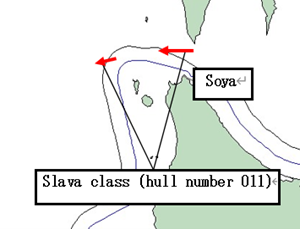 https://www.mod.go.jp/js/pdf/2026/p20260820_02.pdf |
| 8/20 |
On August 20, a Japan-Oman Foreign Ministers’ Meeting was held in Muscat. The Japanese Foreign Minister explained Japan’s intention to promote an updated “Free and Open Indo-Pacific (FOIP)” and to cooperate with Oman for the peace and stability of the Middle East. The Omani Foreign Minister welcomed the promotion of cooperation between the two countries in various fields. They also discussed regional and international situations. Ministry of Foreign Affairs of Japanhttps://www.mofa.go.jp/me_a/me2/om/pageite_000001_00003.html |
| 8/20 |
On August 20, a Japan-India Defense Ministers’ Meeting was held in New Delhi. During the meeting, both ministers agreed to deepen cooperation in maritime security to address concerns in the Indo-Pacific region. In addition, they signed a memorandum on maritime security cooperation, which includes information sharing in the field of Maritime Domain Awareness (MDA) and enhanced cooperation in areas such as search and rescue (SAR) and humanitarian assistance and disaster relief (HADR). Jiji Presshttps://sp.m.jiji.com/english/show/49789 (Reference) Ministry of Defese of Japan https://www.mod.go.jp/en/article/2026/08/d53ab5504adee3c85a14df37a5b7e3108fa885e8.html |
| 8/20 |
On August 20, the Taiwan government proposed the governmental budget for FY 2027. The 2027 budget for defense exceeds NT$1 trillion (US$31.4 billion). The defense budget is 18% higher than the current one and above 3% of GDP. To counter China’s increasing pressure, Taiwan is conducting military modernization and plans to build new submarines. Reuters (Free Malaysia Today)https://www.freemalaysiatoday.com/category/world/2026/08/20/taiwan-proposes-boosting-2027-defence-spending-18 |
| 8/20 |
China is questioning Japan's sovereignty over Okinawa and the Philippines' sovereignty over the Batanes Islands to interfere with the Japan-Philippines maritime boundary talks. Since the 2000s, China has cast doubt on Japan's sovereignty over Okinawa, which experts label as a type of cognitive warfare. Kyodo News (Japanese)https://news.jp/i/1463060488149745693?c=302675738515047521?c=302675738515047521 |
| 8/20 |
The Ministry of Defense of Japan is planning to request ¥8.9 trillion for the defense budget for 2027. However, the total amount of the defense budget is anticipated to increase further because three key strategic documents for Japan’s security are scheduled to be updated. The defense budget request is considered to include the cost to produce long-range attack UAVs and to develop stand-off submarine-launched missiles to counterattack enemy bases The Japan Timeshttps://www.japantimes.co.jp/news/2026/08/20/japan/japan-record-defense-budget-request/ |
| 8/21 |
According to reports, China is considering a multi-layered system that integrates UAVs, USVs, and UUVs to constantly protect the islands. This research comes as China expands its footprint in the South China Sea, with reports noting it could potentially be used for a Taiwan contingency or as a countermeasure against the U.S. military. The Chosun Dailyhttps://www.chosun.com/english/world-en/2026/08/21/ZMHKDDH3DBFZZL2T5V57424KCA/ |
| 8/21 |
The Russian Navy's Pacific Fleet conducted a military exercise simulating an attack on vessels off the coast of Japan’s Northern Territories. Russia stated that a nuclear-powered submarine, a guided-missile cruiser, and a Bastion anti-ship missile system participated in the drill. NHK Worldhttps://www3.nhk.or.jp/nhkworld/en/news/20260821_N01/ |
| 8/21 |
On August 21, China and Indonesia held their first Comprehensive Strategic Dialogue in Jakarta. The foreign ministers of both countries attended the meeting and agreed to work toward an early conclusion of a Code of Conduct (COC) in the South China Sea between China and ASEAN. China and Indonesia also held a foreign and defense ministerial (2+2) meeting and agreed to strengthen defense cooperation. While Indonesia maintains that it follows a neutral foreign policy, the Indonesian Navy recently conducted a joint naval exercise with the Chinese Navy in the waters east of Taiwan, which raised concerns in Taiwan. NHK Worldhttps://www3.nhk.or.jp/nhkworld/en/news/20260822_06/ |
| 8/21 |
The Pacific Islands Forum Fisheries Agency (FFA) announced that authorities in Kiribati, Palau, and Papua New Guinea have detained several Chinese and Indonesian fishing vessels for illegal fishing in the Pacific. While half of the world's tuna is caught in the region, Pacific island countries handle or process only 15% of the catch. AFP (The Strait Times)https://www.straitstimes.com/asia/australianz/pacific-nations-detain-chinese-indonesian-boats-for-illegal-fishing |
| 8/21 |
On August 21, JMSDF confirmed three Russian Steregushchiy class frigates (hull number 333, 335 and 339) sailing west in the waters 30km north of Cape Soya (Hokkaido Prefecture). These vessels sailed west through the Soya Strait. 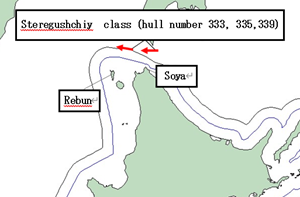 https://www.mod.go.jp/js/pdf/2026/p20260821_02.pdf |
| 8/21 |
On August 21, the Japan Joint Staff confirmed one Russian IL-20 intelligence gathering aircraft flying from the continent over the Sea of Japan. The aircraft flew to the area off the coast of Ishikawa Prefecture, then turned back and flew toward the continent. The JASDF scrambled fighter jets in response to this Russian aircraft. 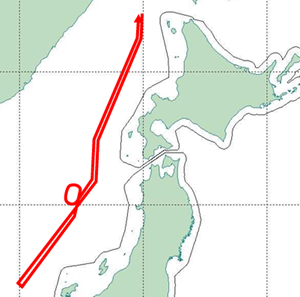 https://www.mod.go.jp/js/pdf/2026/p20260821_03.pdf |
| 8/21 |
On August 21, China stated that three Philippine aircraft had “illegally intruded into” the airspace over Scarborough Shoal without Beijing’s approval. China condemned the action as a violation of its sovereignty and a potential cause of misunderstanding and miscalculation. The Philippine side did not immediately respond to a request for comment. Reuters (Business World)https://bworldonline.com/the-nation/2026/08/21/771740/china-says-philippine-aircraft-intrude-into-airspace-over-scarborough-shoal/ |
| 8/22 |
China announced that it had confirmed and monitored the flight of a U.S. Navy P-8A Poseidon maritime patrol aircraft as it transited the Taiwan Strait. According to flight tracking data, the aircraft took off from Okinawa, passed through the Taiwan Strait, and then headed toward the Bashi Channel. The U.S. 7th Fleet issued a statement, declaring that the flight demonstrates the United States' commitment to a Free and Open Indo-Pacific. Taiwan Newshttps://www.taiwannews.com.tw/news/6426158 |
| 8/24 |
Based on satellite imagery analysis, an expert announced that over 200 Chinese fishing vessels have gathered near Mischief Reef. Mischief Reef is located about 40 km from Second Thomas Shoal, which is effectively controlled by the Philippines. The satellite imagery identified flotillas of 10 to 20 vessels tied together. The expert indicated the possibility that these vessels are being used by the Chinese maritime militia to capture Second Thomas Shoal, as vessels tied together cannot be used for fishing. Mischief Reef has been occupied by China since 1994 and is utilized as a military base. On August 23, China’s Maritime Safety Administration announced that Beijing will conduct a live-fire naval exercise in the northern part of the South China Sea from August 24 to 28. This exercise is regarded as a response to Philippine aircraft entering the airspace over Scarborough Shoal on August 21. The Chosun Dailyhttps://www.chosun.com/english/world-en/2026/08/24/VEXQ6KCI2FHHTBF66PH3XT4A7M/ |
| 8/24 |
On August 22, the JMSDF confirmed that one Chinese Luyang Ⅲ class destroyer (hull number 159) and one Jiangkai-II class frigate (hull number 537) sailing southeast in waters 90km southwest of Kume Island (Okinawa Prefecture). These vessels then proceeded through the waters between Okinawa Island and Miyako Island into the Pacific. On the same day, the JMSDF confirmed that one Chinese Luyang Ⅲ class destroyer (hull number 133) and one Jiangkai-II class frigate (hull number 535) sailing south in waters 70km west of Kume Island. These vessels then proceeded through the waters between Okinawa Island and Miyako Island into the Pacific. 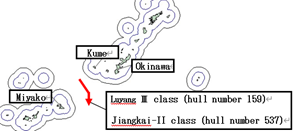 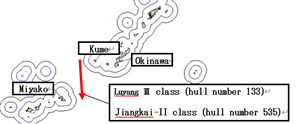 https://www.mod.go.jp/js/pdf/2026/p20260824_02.pdf |
| 8/25 |
On August 25, the Philippine Defense Secretary stated at a congressional meeting that the Philippine Navy intends to acquire two more missile frigates from South Korea. He added that the final decision to acquire has not yet been made. The Philippines is conducting defense equipment modernization to counter China’s pressure in the South China Sea. Inquirerhttps://www.inquirer.net/486126/dnd-eyes-additional-warships-amid-south-china-sea-tensions/ |
| 8/25 |
On August 25, the Japan Joint Staff confirmed one Chinese Y-9 intelligence gathering aircraft flying from the continent through the East China Sea. The aircraft flew toward the area off the coast of Okinawa Island, where it circled. The aircraft then flew back and forth between the area off the coast of Amami Island (Kagoshima Prefecture) and the area off the coast of Okinawa Island. Afterward, the aircraft flew northeast toward the area off the coast of Danjo Island (Nagasaki Prefecture) before returning toward the continent. In response, the JASDF scrambled fighter jets. 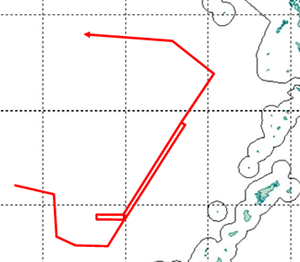 https://www.mod.go.jp/js/pdf/2026/p20260825_02.pdf |
| 8/25 |
China has constructed new buildings in the Paracel Islands. A satellite image taken on August 17 revealed three buildings on Yangong Island. A security expert indicated that some of these structures are similar to other military radar facilities. Additionally, on August 25, China completed the first phase of a construction project at Antelope Reef, also located in the Paracel Islands. Reuters (Devdiscourse)https://www.devdiscourse.com/article/international/3967521-new-installations-emerge-on-islet-as-china-accelerates-south-china-sea-build-up?amp |
| 8/26 |
On August 26, the first Japan-Australia-Indonesia Trilateral Defense Ministers’ Telephone Call was held. The three ministers exchanged views on the security environment in the Indo-Pacific and reaffirmed their commitment to further cooperation to contribute to regional and global peace and stability. Ministry of Foreign Affairs of Japanhttps://www.mod.go.jp/en/article/2026/08/501918b5cf80aaca785f019dcd7aaaa3e21793d2.html |
| 8/26 |
Taiwan’s foreign minister will attend the 55th Pacific Islands Forum and strengthen partnerships with Pacific island countries. During the visit, he will join the 30th Taiwan-Pacific Islands Forum Dialogue. As a development partner, Taiwan has participated in the Pacific Islands Forum since 1993. Taiwan has diplomatic relations with Palau, the Marshall Islands, and Tuvalu. China is expanding its influence in Pacific island countries; as a result, most other members have no diplomatic relations with Taiwan. In addition, Pacific island countries could not reach a consensus on a unified condemnation of China's ballistic missile test-firing in July, which landed in the Pacific Ocean. Taiwan Newshttps://www.taiwannews.com.tw/news/6427985 |
| 8/26 |
On August 26, South Korea announced that its Air Force scrambled fighter jets to intercept a Russian military aircraft attempting to enter the South Korean Air Defense Identification Zone. Officials noted that South Korea detected the Russian aircraft and responded appropriately, adding that the aircraft did not violate South Korean airspace. Kyiv Posthttps://www.kyivpost.com/post/83109 |
| 8/26 |
Australia announced that it conducted a joint maritime exercise with the Philippines and the U.S. from August 19 to 25 in the South China Sea, within the Philippines' Exclusive Economic Zone (EEZ). Australia stated that the objective of the exercise was to strengthen trilateral defense cooperation, ensure freedom of navigation and overflight, and enhance deterrence to maintain security in the Indo-Pacific region. Nova.newshttps://www.agenzianova.com/en/news/South-China-Sea--Australia--the-Philippines--and-the-United-States-strengthen-joint-naval-and-air-maneuvers./ |
| 8/27 |
On August 24, Chinese authorities conducted an inspection of a large saury fishing vessel belonging to the Akkeshi Fisheries Cooperative Association in Hokkaido. The inspection lasted three hours, and authorities did not report any rule infractions. While high-seas vessel inspections are permitted for all countries, a source familiar with the matter stated that a Chinese inspection of a Japanese saury fishing vessel is rare. Hokkaido News UHB (Japanese)https://www.uhb.jp/news/single.html?id=61725 |
| 8/27 |
The Asia Maritime Transparency Initiative (AMTI) stated that the number of China Coast Guard (CCG) vessels appearing near Scarborough Shoal has increased significantly. According to an analysis conducted by AMTI, the CCG dispatched vessels for a total of 933 ship-days near Scarborough Shoal in the first half of this year, compared to 1,099 ship-days in 2025 and 516 in 2024. To counter these Chinese attempts, the Philippine Coast Guard and the Bureau of Fisheries and Aquatic Resources increased law enforcement patrols near Scarborough Shoal. The Manila Timeshttps://www.manilatimes.net/2026/08/27/news/national/chinese-presence-in-masinloc-surges/2412784 |
| 8/27 |
On August 27, the South Korean government announced that it will take tougher measures to counter illegal Chinese fishing vessels near the Northern Limit Line (NLL). South Korea will strengthen its crackdown on Chinese fishing vessels near the NLL, remove illegal fishing gear forcibly, and build additional artificial structures to support these measures. It will also take appropriate steps including diplomatic cooperation and information-sharing between the Coast Guard and the military. Korea JoongAng Dailyhttps://www.koreajoongangdaily.com/korea/govt-to-implement-new-measures-to-crack-down-more-strongly-on-illegal-fishing-near-nll/12847401 |
| 8/27 |
A cross-party delegation of Japanese lawmakers visited China and met with the vice minister of the International Department of the Central Committee of the Chinese Communist Party (CCP). The vice minister stated that withdrawing the Prime Minister’s Diet replies last November regarding a Taiwan contingency was necessary for a change in China's diplomatic policy toward Japan. The two sides also discussed the resumption of cultural exchanges between the two countries, the detention of Japanese citizens, issues related to rare-earth exports, and China's military activities in the East and South China Seas. Kyodo News (Japanese)https://news.jp/i/1465593933772637002 The Japan Time https://www.japantimes.co.jp/news/2026/08/27/japan/politics/japanese-lawmakers-visit-china/ |
| 8/27 |
On August 27, the JMSDF confirmed two Russian Tarantul-III class corvettes (hull number 921 and 924) and one Amga class missile support ship sailing west in waters 40km northwest of Cape Soya (Hokkaido Prefecture). These vessels sailed west through the Soya Strait. 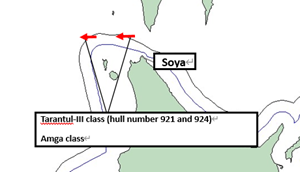 https://www.mod.go.jp/js/pdf/2026/p20260827_02.pdf |
| 8/28 |
The Coast Guard Administration (CGA) of Taiwan announced that China dispatched 244 vessels near Taiwan’s waters last month. This is the highest number on record, consisting of China Coast Guard vessels, maritime research vessels, and other ships. The number of Chinese Navy vessels is not included. Some Taiwanese officials believe China is using these vessels as gray-zone tactics to claim sovereignty over the waters. The CGA also stated that maritime research conducted by Chinese vessels might contribute to building an anti-submarine warfare database for China’s Navy. AFP (Taipei Times)https://www.taipeitimes.com/News/front/archives/2026/08/28/2003863266 |
| 8/28 |
On August 28, a Japan-Chile Foreign Ministers’ meeting was held in Tokyo. The Foreign Minister of Japan welcomed the progress of cooperation toward a resilient supply chain with Chile, which is an important supplier of strategic minerals for Japan, under the concept of the updated “Free and Open Indo-Pacific (FOIP)”. In response, the Foreign Minister of Chile expressed his intention to deepen economic relations by adding high value through Japan’s advanced technologies. They also exchanged views on the situation in East Asia, and reaffirmed close coordination in the international arena. Ministry of Foreign Affairs of Japanhttps://www.mofa.go.jp/press/release/pressite_000001_02608.html |
| 8/28 |
Monthly Statistics on Scrambles(July) The Japan Joint Staff released its monthly statistics on scrambles. In July, the Japan Air Self Defense Force (JASDF) conducted 90 scrambles. The most scrambles were against Chinese aircraft (51 times), followed by Russian aircraft (38 times). Japan Joint Staffhttps://www.mod.go.jp/js/pdf/2026/p20260828_08.pdf |
| 8/28 |
On August 27, the Coast Guard Administration (CGA) announced that it had dispatched a patrol vessel toward a Chinese maritime research vessel sailing in the waters southwest of the Port of Kaohsiung, and warned it by radio not to enter the restricted area. According to the CGA, the Chinese vessel did not enter the restricted area and did not conduct maritime research in those waters. Focus Taiwan (Japanese)https://japan.focustaiwan.tw/cross-strait/202608280004 |
| 8/30 |
On August 30, a Japan-Turkmenistan Foreign Ministers' Meeting and Working Lunch was held. The Foreign Minister of Japan explained the concept of the updated Free and Open Indo-Pacific (FOIP), and the Deputy Chairman of the Cabinet of Ministers and Minister of Foreign Affairs of Turkmenistan stated in response that Japan's effort to realize the concept is important. They also exchanged views on regional and international affairs, and reaffirmed their commitment to continue close coordination in the international arena. Ministry of Foreign Affairs of Japanhttps://www.mofa.go.jp/erp/ca_c/tm/pageite_000001_01786.html |
Newsletter Registration
What is happening in East Asian Maritime Security? The Research Institute for Peace and Security (RIPS) publishes the biweekly newsletter, “East Asian Maritime Security (EAMS)” and updates the information on maritime security relevant to East Asia and Japan's territory.