



Vol.48. June 30. 2026
What is happening in East Asian Maritime Security? The Research Institute for Peace and Security (RIPS) publishes the biweekly newsletter, the information on maritime security relevant to East Asia and Japan's territory.
Monthly Column
Code of Conduct in the South China Sea: A Suboptimal Mechanism or Better Off with None?
by Collin Koh
Senior Fellow, Rajaratnam School of International Studies, Nanyan Techonological University, Singapore
This year has been full of anticipation when it comes to the Code of Conduct in the South China Sea (CoC), now under negotiation between China and the Association of Southeast Asian Nations (ASEAN).
The CoC has a chequered history. It was first conceived of in the wake of the Mischief Reef incident in the 1990s between China and the Philippines. Following years-long talks the Declaration on the Conduct of Parties in the South China Sea (DoC) was promulgated in November 2002 as a first step to an eventual code.(1) Since then, negotiations have been a long-drawn process. Timelines for completion were regularly proposed and then delayed. The COVID-19 interregnum was especially disruptive, since the various parties demurred on continuing the negotiations using virtual platforms instead of the preferred in-person attendance due to travel restrictions.(2) Moreover, back then the concerned governments were more preoccupied with managing the pandemic crisis, hence relegating the talks to secondary importance in the order of policy priorities.
The concerned parties are bent on finalizing the CoC this year, to stick with the guidelines adopted in 2023 to accelerate negotiations.(3) And some of them struck an upbeat tone about it. Early this year for instance, Malaysia claimed, without going into specific details, that 70% of the draft code has been agreed upon between the negotiating parties.(4)
(1) ASEAN Secretariat, Declaration on the Conduct of Parties in the South China Sea. Available at: https://asean.org/declaration- on-the-conduct-of-parties-in- the-south-china-sea-2/
(2) According to Indonesian authorities, COVID-19 delayed the scheduled CoC talks and that it was “very hard” to conduct negotiations virtually. Dian Septiari, “South China Sea rules cannot be negotiated virtually: Indonesian official,” The Jakarta Post, 18 June 2020.
(3) Arlina Arshad and Lim Min Zhang, “China and Asean agree on guidelines to expedite South China Sea negotiations,” The Straits Times, 13 July 2023.
(4) Luqman Hakim and Hakim Mahari, “South China Sea Code of Conduct 70pct agreed, says Tok Mat,” New Straits Times, 12 January 2026.
Spotlight on the Philippines
Of particular interest here is the context. The Philippines is now the rotating chair of ASEAN, and the country has seen arguably the most persistent tension vis-à-vis China amongst all concerned Southeast Asian parties to the South China Sea disputes. Having the code promulgated this year would certainly add plaudits for Manila, which has run an assertive transparency campaign exposing Beijing’s coercive actions in the West Philippine Sea – a move which was unprecedented and in fact, novel, amongst the various ASEAN parties,(5) which have largely opted for low-key, low-profile approaches to handle their disputes with China.
Many of the Philippines’ fellow ASEAN members, not least those involved in the SCS disputes, elected not to publicly comment on Manila’s assertive transparency approach, even though officials privately express concerns that the Philippines’ “name and shame” tactics could have contributed more to tensions than compelling a Chinese rollback in the disputed waters. There was no overt support from ASEAN as an organization, or amongst member states, for Manila’s assertive transparency against Beijing. The Philippines is literally the “outlier” when it comes to how ASEAN parties traditionally handled their sensitive SCS issues with China.
When the Philippines took over the ASEAN chairmanship from Malaysia late last year, it pushed for more meetings in 2026 with the express intent to finalize the CoC.(6) Manila’s intention is clear – it wanted to be seen, especially amongst its ASEAN peers, as a constructive player in pushing for SCS peace and stability, instead of using its bloc chairmanship to pursue its own agenda against Beijing.
(5) For a detailed outline of Manila’s assertive transparency approach, read: Ray Powell and Benjamin Goirigolzarri, “Game Changer: The Philippines' Assertive Transparency Campaign,” jointly published by SeaLight and the Stratbase ADR Institute, January 16, 2024. Available at:https://www.sealight.live/ posts/game-changer-the- philippines-assertive- transparency-campaign-1
(6) Cristina Chi, “Philippines ready to propose more frequent Code of Conduct talks as ASEAN chair,” The Philippine Star, 17 November 2025.
China's Real Motives
If the CoC is indeed finalized and promulgated this year as repeatedly pledged by ASEAN statesmen, the crux of the matter lies not in the timeline but details. This is of great concern because of the apparent scramble, especially amongst ASEAN governments, to get the code finalized soonest. China has publicly evinced its intentions in alignment with the desires of its Southeast Asian counterparts. But it is important to understand Beijing’s real motivations.
Since the DoC was signed in November 2002, China has for years dragged its feet on follow-up talks on the proposed CoC. In the later years of then Chinese President Hu Jintao’s rule, Beijing started to ramp up its coercive activities in the SCS. But the true turning point came with Xi Jinping’s ascendance to power. In April 2012, the same year he took the mantle of leadership, a major incident broke out with the Philippines over Scarborough Shoal and effectively imposed control over this feature that is located well within the Philippine exclusive economic zone. This was the most serious episode since that over Mischief Reef, also under Chinese control. The Scarborough Shoal row led Manila to file a legal suit against Beijing the following year. Instead of participating in the arbitration process, China opted to beef up its physical presence in the SCS with a massive land reclamation and island-building drive.
Throughout those years of its SCS buildup, Beijing paid lip service to the continued necessity of diplomacy to address the dispute especially with Manila, while still dragging its feet on the CoC process. It embarked on a concerted campaign to peddle the narrative that extra-regional parties, especially the United States, were interfering with the SCS disputes and that justified its island-building work as “self-defense” measures against foreign military presence in the area. The period from 2013 till the lead-up to the announcement of the arbitral award on 12 July 2016, was fraught with tensions in the SCS, not least a disturbing series of aerial and maritime close encounters between American and Chinese forces in the area.
The arbitral award eventually dealt a huge blow to China. It basically demolishes Beijing’s basis of historical claims to the SCS, and amongst the most damaging in its final assessment was China’s role in the massive marine ecological damage a s a result of its island-building drive.(7) The award was a major diplomatic and legal humiliation to China, so much so that it continues to insist adamantly that it would never recognize it despite its legally binding nature.
And this is where it becomes interesting. Following the release of the arbitral award, Beijing took a sudden renewed interest in the CoC. It is not far-fetched to argue that this was down to two key motivations. One, China calculated to dilute the arbitral award by pushing the CoC to the forefront with ASEAN. Second, it sought to exclude extra-regional parties from “meddling” in the SCS. In any case, notwithstanding how they perceived Beijing’s real intentions, ASEAN member states welcomed this newfound Chinese enthusiasm for the CoC. Faced with longstanding criticisms over its inability to foster intramural unity and effectively address this “hot button” SCS issue, ASEAN member states wanted to reassert the bloc’s centrality and prove that it is in the driver’s seat. Though of course, this is nothing more than an illusion: Beijing practically drives the process, ASEAN is in the co-driver seat precariously having the driver stay on lane. The failure of the CoC would deal more reputational damage to ASEAN than China. The former literally needs the code more than the latter does. Beijing is likely to emerge more or less unscathed than ASEAN would if the car crashes.
(7) Permanent Court of Arbitration, The South China Sea Arbitration (The Republic of Philippines v. The People's Republic of China). Available at:https://pca-cpa.org/en/cases/7
Devil Lies in the Details
Not only ASEAN wanted to keep Beijing’s fire of enthusiasm burning, but geopolitical and geoeconomic developments to date have also served as motivations. The uncertainty of U.S. commitment to the SCS especially during the first and current second Trump administrations along with the global reciprocal tariffs, worsening flashpoint over Taiwan, the wars in Ukraine, then Gaza, and followed by Iran, have pushed ASEAN member states to accelerate efforts on the CoC. The central assumption is that this code will more effectively manage the SCS disputes and promote peace and stability in the area. In order for the CoC to live up to such an expectation, the teething hurdles that have long persisted in the negotiations have to be overcome.
For example, the geographical scope where the code would apply. There were differences between the parties to the negotiations; notably, Vietnam had earlier wanted to include the Paracel Islands though some other ASEAN parties took the side of Chinese argument that this is purely a bilateral dispute between Beijing and Hanoi thus should not be covered in the code. There was a Chinese proposal in the 2018 Single Draft Negotiating Text, which literally implies a veto over the ASEAN parties’ freedoms to pursue military engagements and joint marine resource development with extra-regional parties. This was pushed back by at least some of the ASEAN governments as an affront to their sovereign prerogatives. In this connection, the role of extra-regional parties also emerged prominently in the discussions. Point to note that Beijing would assiduously seek to avoid any clause in the code that legitimizes a greater role of extra-regional parties and “internationalization” of the SCS disputes.
Prominently, whether the CoC would be binding on all parties, legally or otherwise, has also become a subject of interest. In this regard, ASEAN parties and China appear to be on the same page: all seek a binding and durable CoC. The question about the binding nature of the CoC, however, is a moot one if the parties are unable to effectively address the challenge of compliance, verification and enforcement (CVE). This three-letter term would have been no stranger to anyone familiar with the field of arms control.
CVE is essential for the implementation of any effective arms control mechanism. However, it is similarly applicable to confidence- and security-building measures (CSBMs) such as the CoC. What are the institutional provisions available that ensure compliance with the code by all 12 parties? In the hypothetical – but somewhat likely – event of a purported violation of the code by any of the signatories, what are the institutions that can verify the breach and enforce against the violator? These institutions have to be deemed independent or non-partisan, and avoid being politicized or seen to be polarizing amongst the concerned parties. It is all in all a tall order unable to be satisfactorily addressed by preexisting mechanisms within ASEAN. In any case, it is difficult to assume that Beijing would defer to an ASEAN-led mechanism to implement CVE for the code.
The “Wicked Problem” of Militarization
Before one engages CVE, it is requisite to first define what it means by “militarization”. In the 2018 Single Draft Negotiating Text, Vietnam was the only party that sought to advance this definition, albeit a debatable one. It is a bold attempt, but so far, the jury remains out there on the most commonly accepted definition of militarization. Without defining it clearly, any perceived moves could be labelled as such, as weaponized by one party against the other to suit parochial national interests. And there is already a real-life example. In 2015 during their Rose Garden meeting, Xi pledged to his American counterpart then, Barack Obama, that China “does not intend to pursue militarization” in the SCS.(8) As events unfolded since, Beijing and Washington levelled accusations against each other for militarizing the SCS.
Assume a hypothetical scenario following the promulgation of the CoC that fails to clearly define the scope of militarization: a joint military exercise conducted between an ASEAN party and extra-regional powers could be alleged by Beijing as “militarization”. In response, China would ramp up military and coastguard activities which would then be accused by ASEAN and extra-regional parties as “militarization”. All of them would justify their own actions as “defensive” instead of “militarization” for sure. The biggest bugbear of all would not be about ASEAN member states or China but extra-regional parties – none of them would become signatories to the CoC. Beijing would vigorously resist having extra-regional actors sign onto the code lest it facilitates the “internationalization” of the SCS disputes and legitimizes their presence in the area by acknowledging explicitly their stakeholdership.
Would the CoC mean that ASEAN parties would from then on stop engaging in joint military exercises with extra-regional parties? The answer should be an unequivocal no. External balancing has been part and parcel of the toolkit of ASEAN parties in the SCS, considering the relative asymmetries vis-à-vis China in military and coastguard capacities. Would the CoC mean that Beijing would roll back on its military and coastguard presence in the SCS, including such contentious areas as Scarborough Shoal and Second Thomas Shoal within the Philippine EEZ? Likewise, an unequivocal no. Rolling back on these activities has domestic political repercussions that no political elites sitting in the respective ASEAN capitals or in Beijing would contemplate. Externally, rolling back also sends a bad signal – that the political will to uphold one’s sovereignty and rights in the SCS has reduced.
If there is no explicit attempt to define what is and the scope of militarization and instead deferring to vague wording similar to those found in the DoC, then one could expect the “wicked problem” of SCS actions and counteractions amongst the ASEAN parties and China to persist. Not being involved in the negotiations right from the start and not being invited to sign on to the CoC, extra-regional parties would see no obligation to subscribe to it and consequently curtail their own rights and freedoms in the SCS.
(8) The White House, Remarks by President Obama and President Xi of the People's Republic of China in Joint Press Conference, September 25, 2015. Available at:https://obamawhitehouse. archives.go
Final Push on a Path of No Return?
It is a foregone conclusion that, for all the misgivings about the code and its inherent challenges, ASEAN and China have embarked on a path of no return. The CoC process is irreversible. It would incur more reputational damage to ASEAN than Beijing, which casts more questions about its credibility. Yet not all is lost in this final push for a truly durable and effective code.
Firstly, it is essential for all parties to recognize that the SCS is an international maritime medium, like it or not. The sea lines of communications plying through the area serve as arteries of world trade and hence directly bear upon global economic well-being. It is oft-cited that nobody is sane enough to seek armed conflict in the SCS but not everyone agrees that both littoral states and international users have legitimate economic stakes at least in this semi-enclosed water body. It is time to recognize a need for inclusivity in this common maritime medium. In this regard, the role of extra-regional actors, and their stakes, has to be seriously considered in the CoC.
Secondly, the code needs to be more than just a “DoC-plus” – long on generalities and short on specifics as to lose its meaning and yet open avenues for potential abuse. It is encouraging that, as the 2018 Single Draft Negotiating Text indicated, various parties have proposed ways to promote practical cooperation in the areas of marine environmental protection, maritime and aeronautical search-and-rescue, as well as addressing illegal, unreported and unregulated fishing activities. However, these practical measures should not be the dominant feature in the CoC, as the 2018 draft implies. It is necessary to recognize that adding practical measures that cannot be readily implementable does not help promote the code’s implementation. Rather, the CoC should be firstly a CSBM, secondly a document outlining practical cooperation in those functional areas. Without addressing CSBMs as a prerequisite, practical measures are bound to fail.
Thirdly, there is a need to strike a balance between prescription and flexibility. The envisaged CoC cannot be so prescriptive that it severely constrains the space for parties to exercise some flexibility where necessary, yet should not leave the wordings in the document so open-ended as to create room for individuals to exploit for parochial gains. In particular, if there is no omnibus definition of militarization, there should at least be terms of reference to scope such activities in order to mark out a basic paradigm of “dos and don’ts” for parties. There should be regular working-level meetings to review this scope in accordance with evolving conditions on the ground. In other words, the CSBM-related clauses can be “living provisions” subject to continuous review and not set in stone.
Finally, the CVE challenge has to be addressed and not glossed over for the expediency of hammering out the code by the desired timeline. Without CVE, the code will be anything but effective. While signatories would be bound by CVE obligations, it is necessary to consider scope for participation by extra-regional parties who may not become signatories to the code, either by their own volition or due to resistance from Beijing and ASEAN parties. As a first step, having extra-regional parties agree in principle to the code and its CVE provisions would be helpful. ASEAN parties and China also need to seriously consider establishing the necessary institutions to implement CVE for the code. Without these, the question of whether the code is binding or not, legally or otherwise, is essentially meaningless.
It is poignant that ASEAN and China wanted the code to be finalized and promulgated this year, which marks the tenth anniversary of the SCS arbitral award. But this endeavour should not be geared merely for a grandeur press conference and handshake photo event. An effective and durable CoC requires not just more meetings or more upbeat platitudes from ASEAN policy elites in this final push toward promulgation, but an honest discussion that takes into proper account the real issues on hand regarding its implementation.
Views expressed or implied in this article are solely those of the author. They must not be construed as representing the views and positions of RIPS or any other organizations.
Statistical Data and Analysis (as of June 30)
The highlight of the latter half of June was the G7 Summit. Japan agreed to strengthen security cooperation with various countries. It has also been conducting joint exercises with the Philippines and the U.S. Marine Corps.
Meanwhile, China and Russia were also highly active. China has been voicing increasingly strong opposition to the start of negotiations between Japan and the Philippines on the delimitation of their exclusive economic zones (EEZs) in the Western Pacific at the end of May. In addition to conducting marine surveys around Taiwan, China has stepped up its provocative actions near Japan. In particular, around June 27, large-scale joint flights by Chinese and Russian aircraft took place, and Chinese and Russian naval vessels were spotted in several waters near Japan.
[Statistical Data as of June 30]
The Japan Coast Guard (JCG) daily updates the statistical data on the number of China Coast Guard vessels entering in the contiguous zone around the Senkaku Islands and intruding into Japanese territorial waters. The below is from the website of the JCG.
https://www.kaiho.mlit.go.jp/mission/senkaku/senkaku.html
| June | Contiguous zone |
Territorial Waters |
June | Contiguous zone |
Territorial Waters |
|
|---|---|---|---|---|---|---|
| 15 | 2 | 22 | 4 | |||
| 16 | 2 | 23 | 4 | |||
| 17 | 4 | 24 | 4 | |||
| 18 | 2 | 25 | 4 | |||
| 19 | 2 | 26 | 4 | |||
| 20 | 4 | 27 | 4 | |||
| 21 | 4 | 28 | 4 | |||
| 22 | 4 | 29 | 4 |
Topics
| Date | Topics |
|---|---|
| 6/10 |
Taiwan’s newly acquired American Altius-600 loitering munitions struck maritime targets for the first time in early June during live-fire drills along the island’s west coast. Taiwan has received around 2,000 of the drones to strengthen its anti-invasion capabilities as it shifts toward asymmetric warfare in response to China’s military modernization. Earlier this year, Taiwanese Marines also used domestically developed loitering munitions during drills ahead of the activation of a new littoral combat formation, in which drones are expected to play a key supporting role. Taiwan’s use of American-made drones reflects a broader push toward unmanned systems along the first island chain, with the United States and Japan also expanding drone capabilities to counter China. USNI Newshttps://news.usni.org/2026/06/10/taiwanese-forces-deploy-american-made-attack-drones-against-maritime-targets |
| 6/12 |
China’s Ministry of State Security said on June 12 that foreign intelligence agencies are using new methods to monitor its waters, including sensor-equipped “spy” animals. It alleged that animals such as “spy turtles” and “spy fish” are collecting underwater data like temperature, salinity and currents and transmitting it via satellite, though it provided no evidence or details. The ministry also cited other alleged foreign surveillance tools, including buoys and “wave gliders” said to track submarines or transmit maritime data. It has repeatedly made similar espionage claims in recent years and offers rewards for reports of suspected spy devices at sea. The Guardianhttps://www.theguardian.com/world/2026/jun/12/china-spy-turtles-spy-fish-monitor-waters-claims |
| 6/14 |
Taiwan's National Security Bureau (NSB) on June 14 launched a reporting channel for Chinese nationals to provide intelligence on China, saying the initiative would help broaden its “diverse intelligence sources” and expand the collection of intelligence on China’s political, military, economic, and social developments. It said the initiative draws on similar practices adopted by intelligence agencies in the United States, the United Kingdom, and Israel. To ensure secure communication, the bureau also provides step-by-step instructions in Chinese on how to contact the agency online, and it called on Chinese nationals at home and abroad to actively provide information and “make changes with courage.” Focus Taiwan (The Central News Agency)https://focustaiwan.tw/politics/202606140005 |
| 6/15 |
China’s activities around Taiwan and within the EEZs of Japan and the Philippines reflect a long-term strategy to expand its influence across the First Island Chain and weaken regional alliances and defenses through varying narratives and measures, including coast guard deployments under the pretext of maritime boundary negotiations between Japan and the Philippines, a Taiwanese national security official said June 14, describing the effort as “expansion disguised as law enforcement.” Framing China’s actions solely as a cross-strait issue is a serious misjudgment that undermines Indo-Pacific security and stability, the official said, warning that regional security is approaching a “point of no return” and urging the international community to act before the Indo-Pacific defense framework is breached. The Taipei Timeshttps://www.taipeitimes.com/News/taiwan/archives/2026/06/15/2003859115 |
| 6/15 |
On June 15, Japan-Italy Summit Meeting was held in Rome, Italy. Italy’s prime minister expressed her intention to further strengthen cooperation with Japan, while Japan’s prime minister stressed the importance of close coordination with like-minded countries and her intention to deepen bilateral ties, particularly in security and defense. The two leaders agreed to accelerate joint development of the next-generation fighter aircraft under the Global Combat Air Programme (GCAP). Japan welcomed Italy’s continued engagement in the Indo-Pacific, including a planned port call of an Italian naval vessel in Japan. They also exchanged views on the Indo-Pacific, including China-related issues, and reaffirmed the importance of cooperation for regional peace and stability under the updated Free and Open Indo-Pacific (FOIP) framework. Ministry of Foreign Affairs of Japanhttps://www.mofa.go.jp/erp/erp_1/it/pageite_000001_01683.html |
| 6/15 |
On June 15, Japan’s prime minister attended the G7 Evian Summit working dinner session “Working together to address major international challenges.” G7 leaders exchanged candid views on major international issues, including the Indo-Pacific. Japan’s prime minister outlined Japan’s position on the region, including China-related issues, which have a significant impact on international peace, stability, and prosperity. The leaders agreed to work together to address these challenges. Ministry of Foreign Affiars of Japanhttps://www.mofa.go.jp/fp/pc/pageite_000001_01684.html |
| 6/15 |
A Lowy Institute report on June 15 said China’s ability to strike Australia will grow significantly over the next decade, with near-term threats coming from cyberattacks and potential disruption of undersea communications cables. It said China’s military build-up is already reshaping the Indo-Pacific balance of power and affecting Australian security. A new long-range stealth bomber under development, and possible deployment of missiles and aircraft to bases closer to Australia, could “quickly and dramatically” increase the long-term threat, the report said. It said China has sought basing arrangements in Pacific Island countries, which would bring central Australia within bomber range and enable more frequent attacks. It also noted China’s ability to strike northern Australia from South China Sea outposts and to disrupt Australia’s maritime trade through key chokepoints in the Indonesian archipelago without conventional military operations. Reusters (Asahishimbun News)https://www.asahi.com/ajw/articles/16644468 |
| 6/16 |
On June 16, the Japan-Netherlands Defense Ministerial Meeting was held in Tokyo. Japan’s defense minister welcomed a Dutch naval vessel’s port call, noting it demonstrates Dutch engagement in the Indo-Pacific and contributes to strengthening bilateral defense ties. He also expressed expectations for continued Dutch presence in the region, including deployments of vessels and aircraft. The two ministers exchanged views on defense cooperation, including joint exercises, and regional security, and reaffirmed their intention to maintain close coordination, recognizing the inseparability of Euro-Atlantic and Indo-Pacific security. They also agreed on the importance of the early entry into force of a bilateral acquisition and cross-servicing agreement. Japan Joint Staffhttps://www.mod.go.jp/js/pdf/2026/p20260519_01.pdf |
| 6/16 |
Japanese Ground Self-Defense Force personnel will participate in a parachute drop exercise in the Philippines' northernmost province facing Taiwan later this month, officials said June 15. The free-fall jump, on an island about 200 kilometers from Taiwan, is part of Kamandag, an annual exercise involving Philippine and U.S. marines, with Japan and South Korea joining and other nations observing. The exercise, involving more than 2,200 personnel, runs until July 1. Philippine military officials said it aims to improve readiness, interoperability and intelligence-sharing among partner forces. A bilateral reciprocal access agreement that entered into force last year has enabled the Japanese Self-Defense Force to take part in more advanced exercises. Kyodo Newshttps://english.kyodonews.net/articles/-/77932 |
| 6/16 |
On June 16, Japan’s prime minister held a brief talk with the U.S. president in Evian, France. The two leaders exchanged views on the Indo-Pacific region, including China, and confirmed they would maintain close communication in responding to developments in the region. Ministry of Foreign Affairs of Japanhttps://www.mofa.go.jp/na/na1/us/pageite_000001_01689.html |
| 6/16 |
On June 16, Japan-France Summit Meeting was held in Evian, France. The French president said he wished to further strengthen Japan–France cooperation in various fields, including security. The two leaders agreed to continue working closely, building on their discussions at the G7 Evian Summit chaired by the French president. Ministry of Foregin Affairs of Japanhttps://www.mofa.go.jp/erp/erp_1/fr/pageite_000001_00001.html |
| 6/17 |
On June 16, the Agreement between the Government of Japan and the Government of Canada concerning the Transfer of Defense Equipment and Technology entered into force. The Agreement establishes a legal framework between Japan and Canada for the transfer and control of defense equipment and technology to implement jointly determined projects, including those contributing to international peace and stability. It ensures proper control over transferred equipment and technology, particularly regarding third-party transfers or use beyond the intended purpose. It is expected to strengthen Japan–Canada cooperation in defense equipment and technology and support Japan’s defense industrial base, contributing to Japan’s security. Ministry of Foregin Affairs of Japanhttps://www.mofa.go.jp/press/release/pressite_000001_02427.html |
| 6/17 |
The Pentagon on June 16 restored the name U.S. Pacific Command, reversing the 2018 change that renamed it U.S. Indo-Pacific Command. The move was made to honor the command’s historical roots and long-standing regional role. Established in 1947, Pacific Command is the oldest and largest of U.S. combatant commands. A Pentagon memorandum said the Pacific Command title will serve as a secondary designation, while statutory references to U.S. Indo-Pacific Command remain in place unless Congress changes them. Stars and Stripeshttps://www.stripes.com/theaters/asia_pacific/2026-06-17/pacom-indopacom-name-change-21990270.html |
| 6/17 |
The NDS warns that Australia’s seabed infrastructure, including undersea cables carrying 98% of internet traffic, is vulnerable to sabotage. The Navy is prioritising protection of this infrastructure and underwater warfare capabilities, including robotic and autonomous systems. Australia is adapting to deep-water conditions by using commercial offshore industry technologies and working with AUKUS partners to acquire and adapt existing systems. The RAN is also using an undersea support vessel and deep-sea surveillance systems in exercises and operations, while expanding the use of robotic and autonomous systems. Naval Newshttps://www.navalnews.com/event-news/cne-2026/2026/06/australia-makes-seabed-warfare-a-top-defence-priority/ |
| 6/17 |
On June 17, U.S. Navy officials said Pacific Partnership 2026 is a maritime humanitarian and disaster preparedness mission in the Indo-Pacific, with stops including the Philippines, Timor-Leste, Indonesia, Malaysia, and Vietnam. The five-month mission involves around 300 U.S. personnel and participation from 10 partner nations, including Australia, Japan, South Korea, the United Kingdom, and others, conducting medical, engineering, outreach, and disaster response activities. The initiative is the largest annual multinational humanitarian and civic assistance mission in the Indo-Pacific, aimed at improving regional interoperability and disaster resilience, and traces its origins to the 2004 Indian Ocean tsunami. Philippine News Agencyhttps://www.pna.gov.ph/articles/1277472 |
| 6/18 |
Taiwan has launched its first civil defence drone training programme, inspired by Ukraine’s use of drones in the war. Citizens from teens to retirees are learning basic piloting skills to support surveillance and information‑sharing in a crisis. Drone ownership in Taiwan is rising, and schools and NGOs are expanding drone education. The course uses lightweight, Taiwan‑made, manually operated drones to prepare for electronic jamming. Taiwan aims to build a China‑free drone supply chain. The Guardianhttps://www.theguardian.com/world/2026/jun/18/taiwan-citizens-learn-fly-pilot-drones-courses-china |
| 6/19 |
China says one of its ships conducted a three-day marine survey through June 18 in waters east of Taiwan, which it claims fall under its jurisdiction. Since early this month, China has also carried out maritime activities in the same area, including coast guard patrols and transport ministry operations, to assert jurisdiction over the waters east of Taiwan. China says these actions are countermeasures to maritime boundary talks between Japan and the Philippines, though the survey announcement did not mention the talks. Taiwan has criticized the activities as illegal. NHK Worldhttps://www3.nhk.or.jp/nhkworld/en/news/20260619_02/ |
| 6/19 |
Ukrainian drone maker UFORCE has proposed producing attack drones in Japan for regional defence, as part of broader efforts by Ukrainian firms to expand into Asia through partnerships with Japanese industry, drawing on combat experience in Ukraine and U.S. exercises. As Japan expands investment in drones and other defence capabilities, Ukrainian firms are exploring cooperation with Japan, Taiwan, and the Philippines, while the United States promotes greater use of drones for Indo-Pacific deterrence. Ukrainian companies have also demonstrated drone technologies in Japan and are seeking Japanese and Taiwanese partners for manufacturing and components to reduce reliance on Chinese supply chains. Reuters (The Strait Times)https://www.straitstimes.com/asia/east-asia/ukrainian-drone-makers-target-asia-as-taiwan-tensions-spur-demand |
| 6/21 |
China says it will conduct regular maritime surveys in waters east of Taiwan as part of broader efforts to strengthen its claims over the area through military drills, coast guard patrols, and scientific surveys. Beijing has linked these actions to Japan and the Philippines' maritime boundary talks east of Taiwan, saying they infringe on China's maritime rights. Taiwan says China is increasing pressure around the Taiwan-controlled Pratas Islands, citing what it described as the first coordinated operation by Chinese coast guard and survey vessels earlier this month. The Independenthttps://www.independent.co.uk/asia/china/china-taiwan-martime-surveys-east-sovereignty-b2999876.html |
| 6/22 |
On June 19, the JMSDF confirmed one Chinese Jiangkai-III class frigate (hull number 545) and Fuyu-class support ship (hull number 901) sailing northeast in waters 140km southeast of Miyako Island (Okinawa Prefecture). These vessels sailed northwest through the waters between Miyako and Okinawa Island. These vessels are the same ones that were spotted in the East China Sea on May 19. 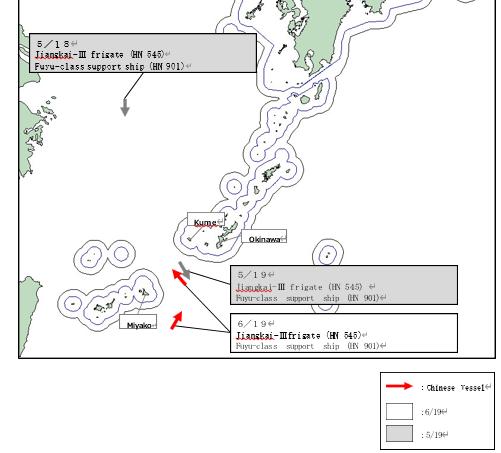 https://www.mod.go.jp/js/pdf/2026/p20260622_01.pdf |
| 6/22 |
On June 19, JMSDF confirmed that one Chinese Jiangkai-II class frigate (hull number 531) sailing southeast in waters 230km west of Yokoate Island. The vessel then navigated through the waters between Amami island and Yokoate Island and entered the Pacific Ocean. 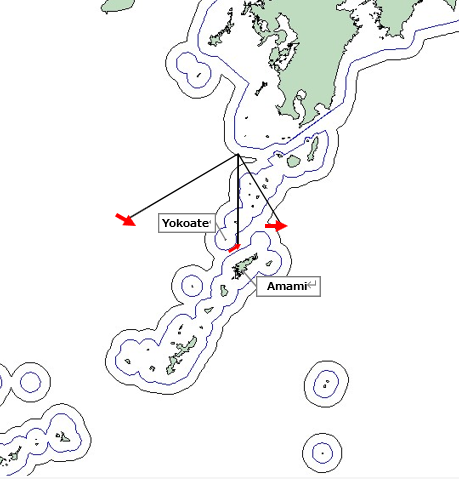 hhttps://www.mod.go.jp/js/pdf/2026/p20260622_02.pdf |
| 6/22 |
On June 20, the JMSDF confirmed one Chinese Admiral Kuznetsov-class aircraft carrier “Liaoning” (hull number 16), one Renhai-class destroyer (hull number 104) and one Luyang-III class destroyer (hull number 124) sailing northwest in waters 130km east of Miyako Island (Okinawa Prefecture). These vessels sailed northwest through the waters between Miyako and Okinawa Island. These vessels are the same ones that were spotted in the Pacific Ocean on May 25. 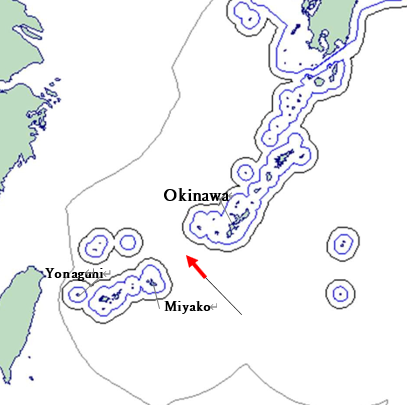 https://www.mod.go.jp/js/pdf/2026/p20260622_03.pdf |
| 6/24 |
The government of Japan confirmed that China is conducting new drilling activities in the East China Sea on June 29. According to the government official, China has anchored a mobile oil drilling rig on the Chinese side of the “Japan-China median line” in the East China Sea. Japan lodged a protest with China and call for early resumption of talks on joint resources development. Jiji Presshttps://sp.m.jiji.com/english/show/48516 The Sankei Shimbun (Japanese) https://www.mod.go.jp/js/pdf/2026/p20260526_01.pdf |
| 6/25 |
On June 25, the JMSDF confirmed two Russian Tarantul-III class corvettes (hull number 921 and 924) and Amga class missile support ship sailing east in waters 50km northwest of Rebun Island (Hokkaido Prefecture). JMSDF also confirmed these vessels sailed east through the Soya Strait. 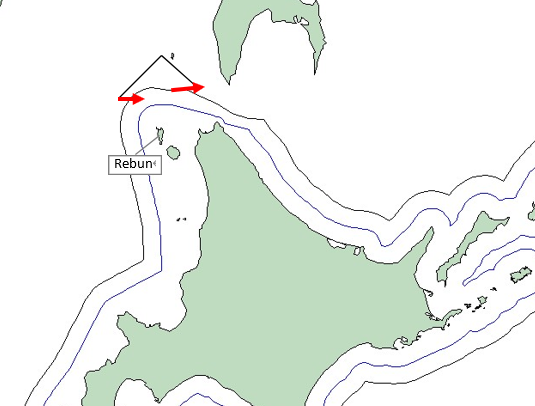 https://www.mod.go.jp/js/pdf/2026/p20260625_02.pdf |
| 6/25 |
On June 25, the JMSDF confirmed one Chinese Luyang-III class destroyer (hull number 117) sailing northeast in waters 80km southwest of Tsushima Island (Nagasaki Prefecture). This vessel sailed northeast through the Tsushima strait and navigated to the Sea of Japan. 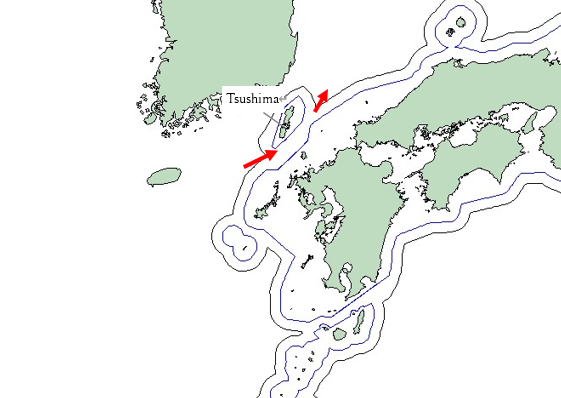 https://www.mod.go.jp/js/pdf/2026/p20260625_01.pdf |
| 6/26 |
On June 25, the JMSDF confirmed one Chinese Luyang-III class destroyer (hull number 119) sailing northeast in waters 70km southwest of Tsushima Island (Nagasaki Prefecture). This vessel sailed northwest through the Tsushima strait and navigated to the Sea of Japan. 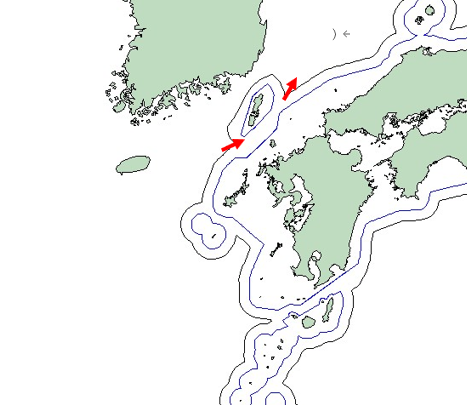 https://www.mod.go.jp/js/pdf/2026/p20260626_01.pdf |
| 6/27 |
On June 27, JSDF confirmed that China and Russia had conducted a joint air patrol around Japan. According to the Japan’s Ministry of Defense, two Chinese H-6 bombers and four Russian Tu-95 and Tu-142 aircraft rendezvoused over the Sea of Japan and conducted a joint flight to the East China Sea. During the joint flight, two Chinese J-16 fighters and one Russian Su-35 fighter also joined the formation. On the afternoon of June 27, two additional Chinese bombers (H-6) flew from the Continent join the Russian bombers and conducted a joint flight from the East China Sea and the Pacific Ocean in the south of Shikoku Island. During the joint flight, one Russian Tu-142 patrol aircraft and four Chinese J-16 fighters joined the formation. At the press conference following the Japan-South Korea defense ministers' meeting in Seoul, Defense Minister Shinjiro Koizumi expressed concern about this joint flight. The Ministry of Foreign Affairs of Japan lodged a protest China and Russia via diplomatic channels. This marks the 11th time that China and Russia have conducted joint patrols since July 2019. 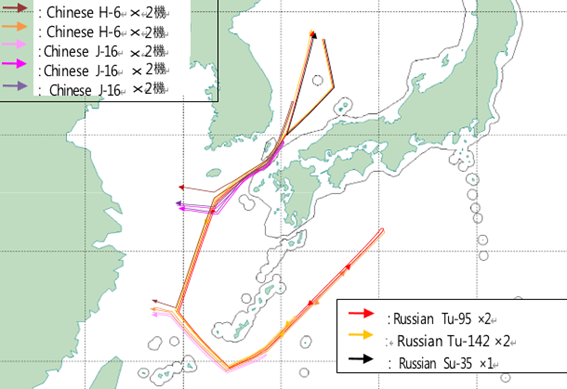 https://www.mod.go.jp/js/pdf/2026/p20260628_01.pdf The Japan Times https://www.japantimes.co.jp/news/2026/06/28/japan/china-russia-bombers-fighters-japan/ NHK World https://www3.nhk.or.jp/nhkworld/en/news/20260628_02/ |
| 6/28 |
The Japan Coast Guard’s 11th Regional Headquarters announced that it had spotted a Chinese research vessel towing something like a pipe within Japan’s exclusive economic zone (EEZ) near the Senkaku Islands. A Japan Coast Guard patrol vessel demanded that the vessel immediately cease its activities, stating that it was not permitted to conduct research without the Japanese government’s approval. Kyodo (Japanese)https://news.yahoo.co.jp/articles/2de39eb33754b1ac76ffb3eaa1116661ffbaabb0 |
| 6/28 |
The ingeniSPACE, a geospatial data analysis firm, and Prof. Aki Mouri found that Chinese coast guard ships had started escorting research vessels and public vessels in the western pacific in mid-July. The area is east of Taiwan and that area is overlapped Japan and the Philippines’ Exclusive Economic Zones (EEZ). Japan and the Philippines began consultation over the demarcation of their EEZ in late May. China has lodged a protest these consultations, and these recent activities are viewed as part of China’s assertion of jurisdiction. Kyodo Newshttps://english.kyodonews.net/articles/-/78825 |
| 6/29 |
On June 26, the JMSDF confirmed one Chinese Jiangkai-II class frigate (hull number 599) sailing south in waters 80km west of the Kume Island (Okinawa Prefecture). This vessel then proceeded through the waters between Okinawa Island and Miyako Island into the Pacific Ocean. 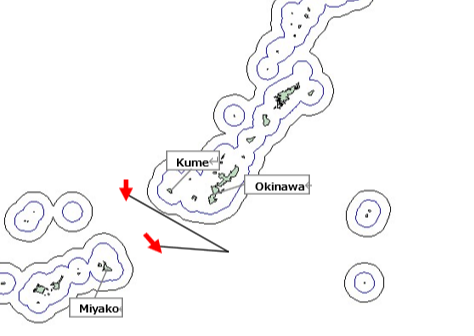 https://www.mod.go.jp/js/pdf/2026/p20260629_04.pdf |
| 6/29 |
On June 26, the JMSDF confirmed one Chinese Luyang-III class destroyer (hull number 132) sailing east in waters 60km southwest of Yokoate Island (Kagoshima Prefecture). The vessel then navigated through the waters between Amami Island and Yokoate Island into the Pacific Ocean. On June 28, the vessel proceeded through the waters between Amami Island and Yokoate Island and entered the East China Sea. 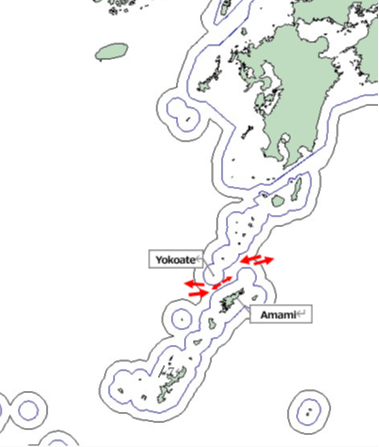 https://www.mod.go.jp/js/pdf/2026/p20260629_06.pdf |
| 6/29 |
On June 27, the JMSDF confirmed Russian Vishnya class Intelligence ship (hull number 208) sailing northeast in waters 110km northeast of Tsushima Island (Nagasaki Prefecture). The vessel then proceeded through the Tsushima Strait into the East China Sea. 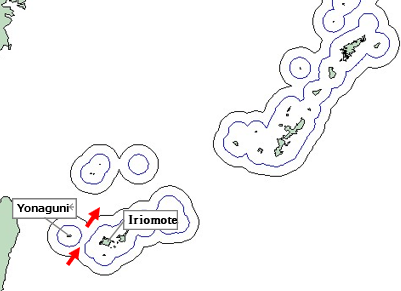 https://www.mod.go.jp/js/pdf/2026/p20260629_06.pdf |
| 6/29 |
On June 27, the JMSDF confirmed that one Chinese Luyang-III class destroyer (hull number 119) sailing southwest in waters 110km northeast of Tsushima Island. The vessel navigated through the Tsushima Strait and entered the East China Sea. This vessel was the same one that proceeded though the Tsushima strait sailing northeast. On June 28, JMSDF also confirmed one Chinese Luyang-III class destroyer (hull number 117) sailing southwest in waters 60km northeast of Tsushima. The vessel then navigated through the Tsushima strait and entered the East China Sea. This vessel was the same one that proceeded though the Tsushima strait sailing northeast. 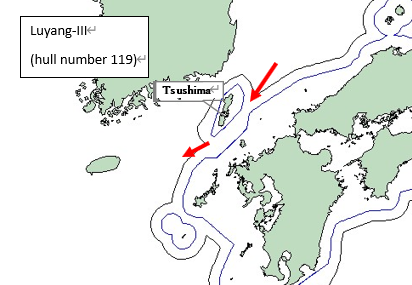 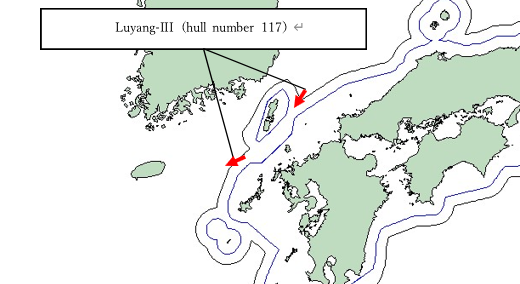 https://www.mod.go.jp/js/pdf/2026/p20260629_06.pdf |
| 6/29 |
On June 27, the JMSDF confirmed that one Chinese Jiangkai-II class frigate (hull number 546) and Fuchi class replenishment oiler (hull number 902) sailing east in waters 110km west of Kuchinoerabu Island (Kagoshima Prefecture). These vessels then proceeded through the Osumi strait into the Pacific Oceean. On June 28, the JMSDF also confirmed one Chinese Renhai class destroyer (hull number 101). The vessel then navigated the Osumi Strait and entered the Pacific Ocean. 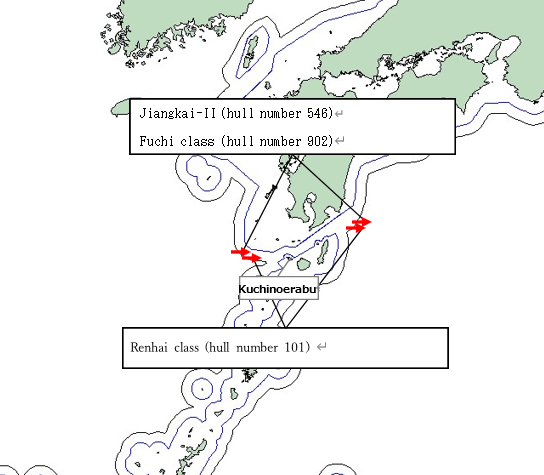 https://www.mod.go.jp/js/pdf/2026/p20260629_08.pdf |
| 6/29 |
On June 28, the JMSDF confirmed one Russian Udaloy-I class (hull number 548) sailing west in waters 50km northwest of the Cape Soya (Hokkaido Prefecture). 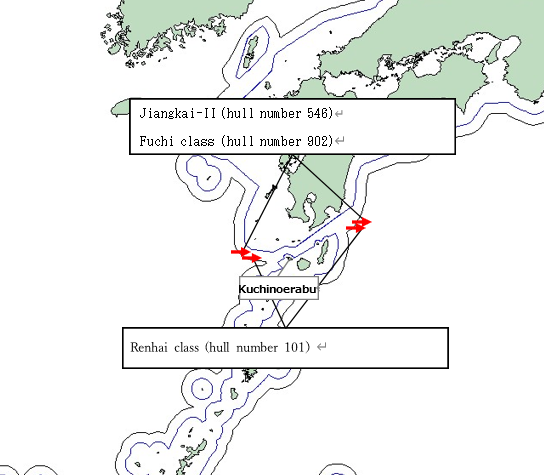 https://www.mod.go.jp/js/pdf/2026/p20260629_08.pdf |
| 6/29 |
On June 27, the JMSDF confirmed that one Chinese Jiangkai-II class frigate (hull number 546) and Fuchi class replenishment oiler (hull number 902) sailing east in waters 110km west of Kuchinoerabu Island (Kagoshima Prefecture). These vessels then proceeded through the Osumi strait into the Pacific Oceean. On June 28, the JMSDF also confirmed one Chinese Renhai class destroyer (hull number 101). The vessel then navigated the Osumi Strait and entered the Pacific Ocean. 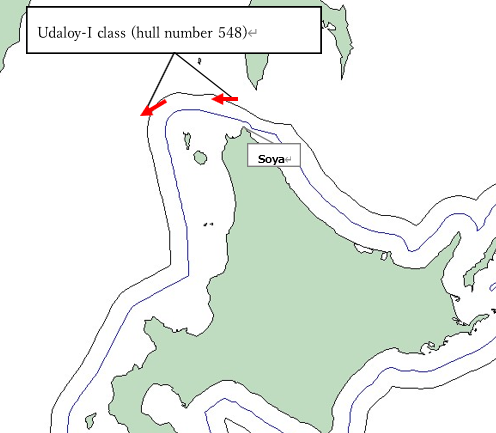 https://www.mod.go.jp/js/pdf/2026/p20260629_08.pdf |
| 6/29 |
On June 27, the JMSDF confirmed that one Chinese Jiangkai-II class frigate (hull number 546) and Fuchi class replenishment oiler (hull number 902) sailing east in waters 110km west of Kuchinoerabu Island (Kagoshima Prefecture). These vessels then proceeded through the Osumi strait into the Pacific Oceean. On June 28, the JMSDF also confirmed one Chinese Renhai class destroyer (hull number 101). The vessel then navigated the Osumi Strait and entered the Pacific Ocean. 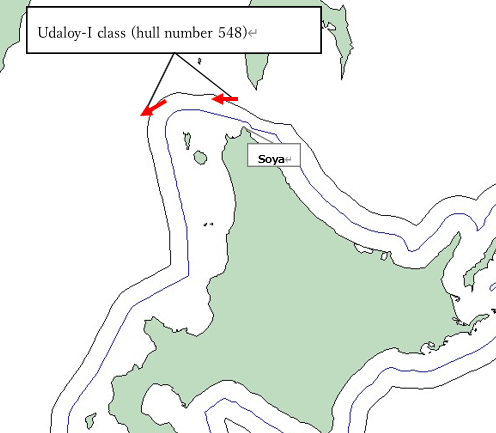 https://www.mod.go.jp/js/pdf/2026/p20260629_08.pdf |
| 6/29 |
On June 29, the JMSDF confirmed one Chinese Dongdiao class intelligence ship (hull number 795) sailing southeast in waters 170km west of Yokoate Island (Kagoshima Prefecture). The vessel then navigated through the waters between Amami Island and Yokoate Island into the Pacific Ocean. 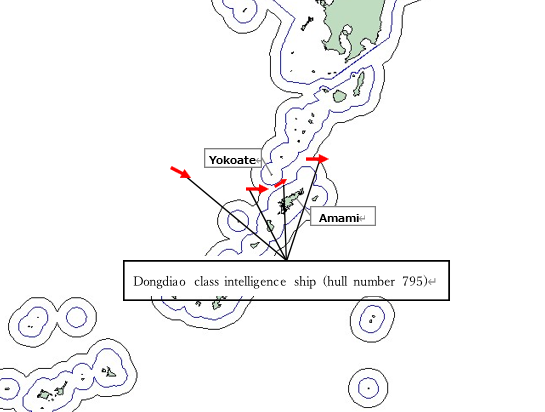 https://www.mod.go.jp/js/pdf/2026/p20260629_05.pdf |
Newsletter Registration
What is happening in East Asian Maritime Security? The Research Institute for Peace and Security (RIPS) publishes the biweekly newsletter, “East Asian Maritime Security (EAMS)” and updates the information on maritime security relevant to East Asia and Japan's territory.