



Vol.47. Jun. 15. 2026
What is happening in East Asian Maritime Security? The Research Institute for Peace and Security (RIPS) publishes the biweekly newsletter, the information on maritime security relevant to East Asia and Japan's territory.
Statistical Data and Analysis (as of Jun. 15)
In the first half of this month, dialogue on security issues progressed in the Indo-Pacific region, and cooperation and collaboration were reaffirmed. The Minister of Defense of Japan, attending the Asia Security Summit (Shangri-La Dialogue), held separate meetings with his counterparts from the United States, Australia, New Zealand, the Philippines, the Republic of Korea, Singapore, and the United Kingdom to exchange views on regional situations and defense cooperation. In his speech, the Minister denied the view that Japan is treading the path of militarism, while strictly criticizing China's large-scale possession and reinforcement of its nuclear capabilities and strategic bombers.
Meanwhile, multiple new unilateral actions by China were observed in the region, including attempts to create a fait accompli regarding its unilateral jurisdictional claims and coercive maritime expansion. Reacting against the announcement of the commencement of formal negotiations between Japan and the Philippines to delimit the maritime boundary of the exclusive economic zone and the continental shelf, China dispatched government vessels to the waters east of Taiwan and conducted patrol activities such as inspecting merchant ships and conducting hydrographic surveys (which Taiwan condemned as a provocative act and cognitive warfare). In connection with this, when Chinese Coast Guard vessels navigated through Japan’s EEZ south of Okinawa Prefecture, China claimed for the first time that the area was “under Chinese jurisdiction.” In addition, the installation of a new floating structure by China was confirmed within the Scarborough Shoal in the South China Sea.
[Statistical Data as of Jun. 15]
The Japan Coast Guard (JCG) daily updates the statistical data on the number of China Coast Guard vessels entering in the contiguous zone around the Senkaku Islands and intruding into Japanese territorial waters. The below is from the website of the JCG.
https://www.kaiho.mlit.go.jp/mission/senkaku/senkaku.html
| May | Contiguous zone |
Territorial Waters |
Jun. | Contiguous zone |
Territorial Waters |
|
|---|---|---|---|---|---|---|
| 29 | 4 | 6 | 4 | |||
| 30 | 4 | 7 | 4 | |||
| 31 | 4 | 8 | 4 | |||
| Jun. | Contiguous zone |
Territorial Waters |
9 | 4 | ||
| 10 | 4 | 4 | ||||
| 1 | 4 | 11 | 4 | |||
| 2 | 4 | 12 | 4 | |||
| 3 | 4 | 13 | 4 | |||
| 4 | 4 | 14 | 4 | |||
| 5 | 4 |
Topics
| Date | Topics |
|---|---|
| 5/29 |
On May 29, Japan’s defense minister paid a courtesy call on the general secretary and president of Viet Nam in Singapore. Japan’s minister expressed his intention to further strengthen the Comprehensive Strategic Partnership with Viet Nam and advance defense cooperation toward a Free and Open Indo-Pacific (FOIP). He emphasized maritime security cooperation and outlined Japan’s policy of contributing to regional and international peace and stability in light of the recent revision of the Three Principles on Transfer of Defense Equipment and Technology. Both sides concurred on further strengthening defense cooperation, including in defense equipment and technology. Ministry of Defense of Japanhttps://www.mod.go.jp/en/article/2026/05/ab09ffde7ecd95decc69699cf915e0ecab70591e.html |
| 5/30 |
On May 30, the Japan–Australia–New Zealand Trilateral Defence Ministers’ Meeting was held in Singapore. The Ministers confirmed their intention to cooperate toward a free and open Indo-Pacific, reaffirmed their commitment to Pacific peace and security under the leadership of the Pacific Islands Forum, and agreed to deepen discussions on cooperation in the Pacific. They also confirmed their commitment to enhancing trilateral interoperability through joint training and exercises, and concurred that such collaboration contributes to regional stability in the Indo-Pacific. Ministry of Defense of Japanhttps://www.mod.go.jp/en/article/2026/05/2e70eb25f46a97ed06aaa258fc55eed062a309a1.html |
| 5/30 |
On May 30, the Japan–UK Defense Ministerial Meeting was held in Singapore. The two ministers discussed regional affairs and reaffirmed that the security of the Euro-Atlantic and Indo-Pacific is inseparable. They also confirmed their commitment to maintaining a security environment that does not tolerate attempts to change the status quo by force. Ministry of Defense of Japanhttps://www.mod.go.jp/en/article/2026/05/9cc07ea4d1c5df95d557cb47d58bcf77e7920016.html |
| 5/30 |
On May 30, the Japan–New Zealand Defense Ministerial Meeting was held in Singapore. The ministers agreed to continue to work closely together to deepen cooperation with Pacific Island countries and welcomed discussions at the 2026 Japan-Pacific Islands Defense Forum and the 2025 South Pacific Defence Ministers’ Meeting. They noted improved interoperability through a Japan–New Zealand naval exercise and agreed to deepen cooperation through similar exercises. Ministry of Defense of Japanhttps://www.mod.go.jp/en/article/2026/05/0072d6ab60152384d27e0fd77935297c797ad168.html |
| 5/30 |
On May 30, the Japan–U.S. Defense Ministerial Meeting was held in Singapore. Japan’s minister explained the revision of the defense equipment and technology transfer framework and Japan’s progress in reinforcing its defense capabilities, which the U.S. secretary welcomed, expressing support for Japan’s efforts to enhance regional deterrence and stability. They exchanged views on regional affairs, including China, and reaffirmed close coordination in response to the increasingly severe security environment in the Indo-Pacific. They also agreed to deepen cooperation with regional partners, including Australia, the Republic of Korea, and the Philippines, and welcomed progress in trilateral cooperation with Australia under the Trilateral Defense Consultations. Ministry of Defense of Japanhttps://www.mod.go.jp/en/article/2026/05/66f437bf4189f312a0a26ef11ccd7c3dea3be3c3.html |
| 5/31 |
On May 31, the Japan–Philippines Defense Ministerial Meeting was held in Singapore. Japan’s minister expressed his intention to further strengthen bilateral defense relations, and the Philippine secretary agreed to continue close coordination under the Free and Open Indo-Pacific (FOIP). The ministers reached a broad consensus to advance discussions on the transfer of destroyers and training aircraft, welcomed steady progress in defense cooperation and concurred on further strengthening it. They also shared the view that defense cooperation between Japan and ASEAN should be strengthened, noting the Philippines’ role as ASEAN Chair this year. Ministry of Defense of Japanhttps://www.mod.go.jp/en/article/2026/05/45c008f13e32cdb63ef16520e4337fe3fd601788.html |
| 5/31 |
On May 31 at the Shangri-la Dialogue in Singapore, Japan's defence minister rebutted Beijing's claim that Japan was engaging in "new militarism". He said there is a country with a "huge arsenal of nuclear weapons and strategic bombers", while Japan has none, and questioned why Japan is labelled "new militarism". He also said China's rising defence spending and expanding military capabilities lack transparency and are a matter of serious concern for Japan and the international community, adding that "Japan's door is always open" for communication with China. In his speech, he said it was "only natural" that every country, including Japan, updates its defences to meet new challenges and contribute to peace in the region. He added that Japan would proceed "with a high degree of transparency" and engage in constant dialogue with other countries, clearly explaining what capabilities are being developed and why. BBChttps://www.bbc.com/news/articles/cp8p4ejy8ppo (Reference) Japan’s defense minister’s speech at the 23rd Shangri-La Dialogue https://www.mod.go.jp/en/images/62f90e430299305b0a441b5cb455d449230f9c82.pdf |
| 5/31 |
On May 31, South Korean Defense Minister said he and his Japanese counterpart discussed a possible Acquisition and Cross-Servicing Agreement (ACSA) during their May 30 meeting in Singapore. It was the first time under President Lee Jae-myung’s administration that South Korea’s defence authorities officially acknowledged discussing an ACSA with Japan. The Japanese government has long pushed for such an agreement, while the South Korean Defense Minister said, “We still believe that we should remain cautious.” Jiji Press Newshttps://sp.m.jiji.com/english/show/48027 (Reference) Ministry of Defense of Japan https://www.mod.go.jp/en/article/2026/05/6d1a38aa3a6cb0a853f3cea415e7e523b9c1e145.html |
| 6/1 |
On May 30, the U.S. Defense Secretary spoke at the Shangri-La conference in Singapore, assuring Pacific allies of continued U.S. commitment to the region, but softening earlier rhetoric on China. He said the region had “profound implications for U.S. security and prosperity” and that Washington’s priority was to maintain a favorable balance of power in the Pacific and prevent any hegemon from dominating the Indo-Pacific, citing concerns over China’s military buildup. He said there was “no change in our status” toward Taiwan and declined to comment on arms sales, saying decisions would rest with the president. He called on allies to increase defence spending and criticised some European countries for “empty globalist rhetoric” about the rules-based international order. The Australian Defence Minister said the order should be reformed rather than dismantled, warning that when power overrides rules, smaller states lose agency. The Associated Press (Asahi Shimbun News)https://www.asahi.com/ajw/articles/16606709 (Reference) Pete Hegseth’s Remarks at the 2026 Shangri-La Dialogue https://www.war.gov/News/Speeches/Speech/Article/4504755/remarks-by-secretary-of-war-pete-hegseth-at-the-2026-shangri-la-dialogue-in-sin/ |
| 6/1 |
On May 31, the Japan–Singapore Defense Ministerial Meeting was held in Singapore. The two ministers welcomed active people-to-people and defence exchanges and agreed to continue them on a regular basis. They also agreed to promote cooperation in defence equipment and technology, maintain regular consultations in light of the increasingly challenging regional security environment, and strengthen defence cooperation between Japan and ASEAN to contribute to regional peace and stability. Ministry of Defense of Japanhttps://www.mod.go.jp/en/article/2026/05/716f217abb4e97df6c2e706d732d19f98fd48131.html |
| 6/1 |
It has been revealed that maps and books published by North Korea last year showing its territory do not include Takeshima, which Japan considers to be its inherent territory. Until now, both South Korea and North Korea had claimed sovereignty over Takeshima, asserting it was an “inherent island of Korea,” and it had been included in past maps. Since late 2023, North Korea has revised its constitution to define its territory as limited to the northern half of the Korean Peninsula. An expert suggested that North Korea may have abandoned its claim to Takeshima. Kyodo Newshttps://english.kyodonews.net/articles/-/77110 |
| 6/1 |
On May 26, the Japan Maritime Self Defense Force (JMSDF) confirmed one Chinese Admiral Kuznetsov class aircraft carrier Liaoning (hull number 16), one Chinese Renhai class destroyer (hull number 104) and one Chinese Jiangkai III class frigate (hull number 545) sailing in waters 1,090km southwest of Oki-no-Tori Shima Island. On May 27, the JMSDF confirmed one Admiral Kuznetsov class aircraft carrier Liaoning (hull number 16), one Renhai class destroyer (hull number 104) and one Chinese Luyang III class destroyer (hull number 124) sailing in waters 790km south of Miyakojima Island. On May 28, the JMSDF confirmed one Admiral Kuznetsov class aircraft carrier Liaoning (hull number 16), one Renhai class destroyer (hull number 104), one Luyang III class destroyer (hull number 124), one Jiangkai III class frigate (hull number 545) and one Chinese Fuyu class fast combat support ship (hull number 901) sailing in waters 590km southwest of Miyakojima Island. On May 26, the JMSDF confirmed approximately 80 takeoffs and landings by carrier-based fighter aircraft and helicopters from the aircraft carrier Liaoning; on May 27, approximately 50 additional takeoffs and landings; on May 28, approximately 40 additional takeoffs and landings. As a result, the total number of takeoffs and landings confirmed between May 26 and May 28 amounted to approximately 170. On May 29, the JMSDF confirmed one Admiral Kuznetsov class aircraft carrier Liaoning (hull number 16), one Renhai class destroyer (hull number 104) and one Luyang III class destroyer (hull number 124) sailed southeast in waters east of the Philippines in the Pacific Ocean. 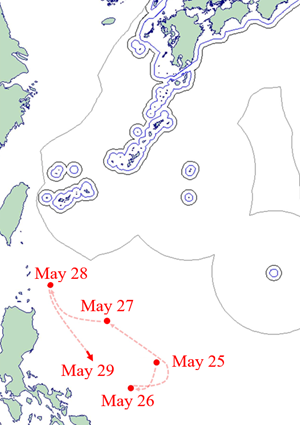 https://www.mod.go.jp/js/pdf/2026/p20260601_01.pdf |
| 6/1 |
On May 26, Mr. Oue, Special Adviser to the Japanese Prime Minister, paid a courtesy call on the Prime Minister of Papua New Guinea and held discussions with the Commander of the Papua New Guinea Defence Force and the Deputy Secretary of Foreign Affairs, expressing Japan’s intention to strengthen bilateral relations and work together for regional peace, stability and security. The sides exchanged views on regional affairs and agreed to promote security cooperation. On May 28–29, he paid a courtesy call on the Crown Prince Regent of Tonga and held discussions with the Chief of the Tonga Defence Force, expressing Japan’s intention to promote regional peace, stability and security and agreeing to further strengthen security cooperation. Ministry of Foreign Affairs of Japan (Japanese)https://www.mofa.go.jp/mofaj/a_o/ocn/pageit_000001_00004.html |
| 6/1 |
On June 1, the leaders of Vietnam and the Philippines met in Manila and reaffirmed the importance of freedom of navigation in the South China Sea. They agreed to strengthen coordination and promote peace, stability, and a rules-based order anchored in international law. Both countries elevated their ties to an enhanced strategic partnership and renewed their defense cooperation agreement to strengthen maritime security capabilities amid China’s growing assertiveness in the South China Sea. Vietnam has stepped up maritime patrols and security cooperation with regional partners while maintaining close economic ties with China. At the Shangri-La Dialogue in Singapore, the Vietnamese leader said military power alone cannot ensure security and called for mechanisms to prevent conflicts from escalating, warning against a regional order where “the big fish swallows the small fish.” Bloomberg (The Japan Times)https://www.japantimes.co.jp/news/2026/06/01/asia-pacific/politics/vietnam-philippines-ties-south-china-sea/ |
| 6/1 |
The Chinese Navy said on June 1 that China and the U.S. held “candid and constructive” military talks in Hawaii on May 28–29 on air and maritime safety, attended by military representatives from both sides. It said both sides agreed that improved communication could reduce miscalculations and enhance professionalism, and reiterated China’s opposition to any actions that undermine its sovereignty and security. A separate statement from the U.S. Indo-Pacific Command said it hosted representatives of the Chinese People’s Liberation Army in Honolulu for discussions focused on reducing the risk of unsafe and unprofessional encounters. Reutershttps://www.reuters.com/world/china/chinese-us-militaries-met-hawaii-stressed-communication-chinese-navy-says-2026-06-01/ |
| 6/2 |
On June 2, Vice Minister of Foreign Affairs of Japan held a Vice Ministers’ meeting Secretary of Foreign Affairs and Trade of New Zealand in Japan. In light of the current severe strategic environment, the two sides agreed to further strengthen security cooperation between Japan and New Zealand as “Strategic Cooperative Partners.” They also discussed Indo-Pacific issues, including in the Pacific Islands, and agreed to work with regional partners to advance the updated “Free and Open Indo-Pacific” initiative. Ministry of Foreign Affairs of Japanhttps://www.mofa.go.jp/press/release/pressite_000001_02379.html |
| 6/2 |
On June 2, Japan’s defense minister paid a courtesy call on Palau’s president in Tokyo. Both sides reaffirmed their shared commitment to a Free and Open Indo-Pacific and agreed to further strengthen Japan–Palau defense cooperation to contribute to regional peace and stability. The minister also welcomed Palau’s participation in the Japan–Pacific Islands Defense Dialogue and reiterated the importance of cooperation in areas such as maritime security with Pacific Island countries. Ministry of Defense of Japanhttps://www.mod.go.jp/en/article/2026/06/f2131590165643194ea76ee37d113c091ee4446b.html |
| 6/2 |
Satellite imagery has captured an unidentified object at the entrance to Scarborough Shoal in the South China Sea. Experts assessed it is less than 10 meters in diameter and unclear whether it is fixed to the reef or floating. They said a fixed installation could raise questions under the 2002 Declaration on the Conduct of Parties in the South China Sea. Philippine officials said they are verifying its nature and origin. On June 2, the Philippine military said it tracked 82 Chinese coast guard and navy vessels in its exclusive economic zone in May, including 39 near Scarborough Shoal. The number of Chinese vessels increased between May 26 and June 1, when the United States joined the Philippines for a joint patrol near the shoal. The Philippine Defense Secretary said at the Shangri-La Dialogue that the Philippines will maintain a “constant presence” near Scarborough Shoal with coast guard and navy forces. Newsweekhttps://www.newsweek.com/satellite-image-shows-possible-chinese-structure-disputed-reef-12019748 |
| 6/3 |
At last week’s summit in Tokyo, Japan and the Philippines agreed to begin formal talks on delimiting their maritime boundary east of Taiwan, including the exclusive economic zone and continental shelf. On June 1, the China Coast Guard began patrolling the area in response. On June 2, China opposed the talks, asserting the area is part of its exclusive economic zone and continental shelf, while Taiwan said it should be included, citing overlap with waters it claims rights to. Also on June 1, Japan’s Chief Cabinet Secretary said any Japan–Philippines agreement would define their respective rights and obligations and would not legally bind third parties or violate international law. NHK Worldhttps://www3.nhk.or.jp/nhkworld/en/news/20260603_N01/ |
| 6/3 |
The Island States Ocean Summit, hosted by The Nippon Foundation and co-hosted by the Ministry of Foreign Affairs of Japan and UNESCO/IOC, was held in Tokyo on June 3 and 4, bringing together more than 300 participants from around 30 countries and organizations to discuss ocean-related issues facing island states. On June 3, Japan’s prime minister attended as guest of honor. She expressed her desire to work together under the Updated “Free and Open Indo-Pacific (FOIP)”, reaffirmed support for countries affected by climate change and cooperation to enhance Maritime Domain Awareness (MDA) and maritime law enforcement agencies, and expressed her wish to work with other nations to achieve sustainable oceans based on the rule of law. Ministry of Foreign Affairs of Japanhttps://www.mofa.go.jp/ic/ge/pageite_000001_00001.html |
| 6/3 |
The Solomon Islands’ new prime minister said on June 3 that the government would review its 2022 security treaty with China, which had raised concerns in the United States and Australia over a possible Chinese naval presence in the South Pacific. The leaders of the Solomon Islands and Australia also announced plans to negotiate a comprehensive strategic treaty covering security and economic cooperation, with the Australian prime minister emphasizing Australia’s role as the Solomons’ primary security partner. Meanwhile, China said it was ready to work with the new Solomon Islands government to expand practical cooperation. The Associated Presshttps://apnews.com/article/australia-china-security-solomon-islands-treaty-a0a24e89875f308b2d52d384097a0bdb |
| 6/3 |
China is launching submarines at a pace unmatched by any other nation. The latest, a previously unreported and unexpected type, has just been observed in Shanghai in recent satellite imagery. The main distinguishing features of the boat are its sleek bow, X-form rudders, and minimal sail. The submarine is longer but narrower than the vessel first reported in February and provisionally identified as the Type-095 (Type-09V) attack submarine, indicating a new class. It seems unlikely the new submarine is a ballistic missile boat (SSBN). Questions remain about its role and propulsion, though its size suggests standard nuclear propulsion is most likely. Naval Newshttps://www.navalnews.com/naval-news/2026/06/new-mystery-submarine-signals-chinas-rapid-undersea-expansion/ |
| 6/4 |
On June 3, the JMSDF confirmed one Russian Udaloy class destroyer sailing northeast in waters 50km west of Rebun Island (Hokkaido Prefecture). From June 3 to 4, this vessel sailed east through the Soya Strait. 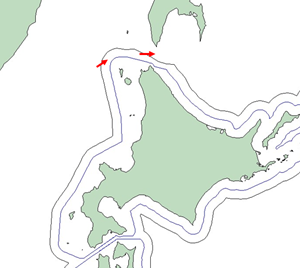 https://www.mod.go.jp/js/pdf/2026/p20260604_01.pdf |
| 6/4 |
The Commandant of the Japan Coast Guard participated in the Asia Security Summit (Shangri-La Dialogue) in Singapore from May 29. During the session “Disruptions to Maritime Security in Asia,” participants discussed how international law and multilateral cooperation can help maintain stability amid growing instability in Asia’s maritime order. The Commandant also exchanged views with representatives of coast guard agencies and other maritime authorities from various countries, reaffirming the importance of a rule-based maritime order. Japan Coast Guard (Japanese)https://www.kaiho.mlit.go.jp/info/kouhou/r8/k260604_1/k260604_1.pdf |
| 6/5 |
On June 5, former residents of the Russian-held northwestern Pacific islands claimed by Japan, collectively called the Northern Territories in Japan, will hold memorial services for their ancestors at sea and in the air between July and November, the prefectural government of Hokkaido said. The events will take place as exchange programs have been suspended due to Russia’s invasion of Ukraine, with the at-sea memorial service to be held since 2022. This year, an aerial memorial service is planned in consideration of the physical burden on former residents, whose average age is over 90. Jiji Press Newshttps://sp.m.jiji.com/english/show/48143 |
| 6/6 |
China said it was monitoring the Dutch frigate Zr. Ms. De Ruyter in the Taiwan Strait after the vessel’s earlier passage near the Paracel Islands, which Beijing described as illegal. The Dutch Ministry of Defense rejected the claim, stating that the frigate was operating lawfully. The vessel is currently deployed in the region as part of an international naval exercise and is conducting port visits to strengthen diplomatic, security, and economic ties with regional partners. ANP (NL Times)https://nltimes.nl/2026/06/06/chinas-military-tracks-dutch-warship-taiwan-strait-calls-earlier-passage-illegal |
| 6/8 |
On June 8, the Second Japan–U.S.–Philippines Maritime Dialogue was held in Manila, attended by foreign affairs, defense, and coast guard officials from the three countries, led respectively by the Deputy Director-General for Southeast and Southwest Asian Affairs of Japan’s Ministry of Foreign Affairs, the U.S. Assistant Secretary of State for East Asian and Pacific Affairs, and the Philippine Undersecretary for Policy. The three parties welcomed progress in trilateral cooperation and reaffirmed its importance. They exchanged views on the South China Sea, reaffirming their opposition to any unilateral attempts to change the status quo by force or coercion, and the significance of the Arbitral Tribunal’s award on its 10th anniversary. They also agreed to strengthen complementary bilateral initiatives while sustaining momentum for trilateral cooperation. Ministry of Foreign Affairs of Japanhttps://www.mofa.go.jp/press/release/pressite_000001_02398.html |
| 6/8 |
China was angered by Japan and the Philippines’ announcement last month that they would begin formal talks on delimiting their maritime boundaries, which Beijing sees as involving waters off Taiwan. On June 6, Chinese state media reported that vessels had been deployed for a “special maritime traffic law-enforcement operation” east of Taiwan in response. Taiwan’s Coast Guard sent ships and said Chinese vessels were “expelled” from restricted waters on June 7. On June 8, Taiwan’s Defence Minister said Chinese Coast Guard patrols east of Taiwan are a “provocative act” and “cognitive warfare,” calling them a serious affront to national sovereignty. Reuters (The Japan Times)https://www.japantimes.co.jp/news/2026/06/08/asia-pacific/politics/taiwan-china-coast-guard/ |
| 6/9 |
The JCG says two China Coast Guard vessels entered Japan’s EEZ south of Yonaguni Island, Okinawa Prefecture, after sailing east of Taiwan on June 3. When the JCG made a radio call, the Chinese crew replied that they were conducting a routine patrol in waters under China’s jurisdiction, a claim Japanese officials believe is the first of its kind in the area. According to ship tracking data, the vessels remained in surrounding waters through June 8. Chinese officials said Japan and the Philippines’ decision to begin maritime boundary talks “seriously infringed upon China’s territorial sovereignty and maritime rights and interests.” Japan responded that any resulting agreement would affect only the two countries’ rights and obligations and would neither bind third parties nor violate international law. NHK Worldhttps://www3.nhk.or.jp/nhkworld/en/news/20260609_03/ |
| 6/9 |
Taiwan’s military on June 9 simulated repelling a Chinese amphibious invasion in a coastal exercise, employing Thunderbolt-2000 rocket systems, U.S.-made Paladin howitzers, anti-tank missiles, artillery, and mortars. Conducted from eight positions along a 20-km stretch of coast near Taichung, the drill featured reduced preparation time and more realistic, less predictable combat scenarios. Reuters (Asahi Shimbun News)https://www.asahi.com/ajw/articles/16629542 |
| 6/9 |
On June 9, in Tokyo, Vice-Minister for Foreign Affairs of Japan held a meeting with State Secretary of the Federal Foreign Office of Germany. Both sides confirmed they will strengthen ties across various fields, including security and defense. Japan’s vice-minister explained initiatives on the evolution of a "Free and Open Indo-Pacific (FOIP)," confirming deeper cooperation toward its realization. They also exchanged views on regional topics, including the situation in the Indo-Pacific. Finally, they agreed to further cooperation both bilaterally and in international forums like the G7. Ministry of Foreign Affairs of Japanhttps://www.mofa.go.jp/press/release/pressite_000001_02403.html |
| 6/9 |
On June 9, China’s state-run Xinhua News Agency reported that a fleet of Chinese government vessels held a national flag-raising ceremony in waters east of Taiwan on June 8. The ceremony took place near the waters subject to boundary negotiations between Japan and the Philippines, apparently aimed at countering both countries and asserting China's jurisdiction over the area. At a press conference on June 9, a Chinese Foreign Ministry spokesperson reiterated the claim that China’s EEZ and continental shelf extend to the waters east of Taiwan. Kyodo News (Japanese)https://www.47news.jp/14443455.html |
| 6/9 |
Taiwan's coast guard said on June 9 that since June 7, Chinese coast guard ships had "harassed" three passing commercial ships around Taiwan by demanding their origin and destination information and claiming jurisdiction. In response, Taiwan's coast guard broadcasted that China had no jurisdiction in Taiwanese waters, telling the Chinese vessels not to harass ships and advising the merchant ships to ignore the inquiries. The coast guard added that passing ships maintained normal navigation and were not boarded or interfered with by the Chinese vessels. Responding to increased Chinese coast guard activity, a U.S. State Department spokesperson urged Beijing to cease pressure on Taiwan and instead engage in peaceful dialogue. Reuters (Nikkei Asia)https://asia.nikkei.com/politics/international-relations/taiwan-tensions/taiwan-says-china-coast-guard-harassed-commercial-shipping-off-its-coast |
| 6/10 |
Four Chinese coast guard vessels entered Japanese territorial waters off the Senkaku Islands on June 10. Their hull numbers are 2501, 2301,2303 and 2304. This was the first such incursion since May 26. According to the JGC, the four vessels were spotted around Uotsuri Island, part of the Senkaku chain, sailed inside the area for roughly 90 minutes before leaving the area. Jiji Press Newshttps://jen.jiji.com/jc/eng?g=eco&k=2026061001150 Yaeyama Nippo (Japanese) https://www.yaeyama-nippo.co.jp/archives/30527 |
| 6/10 |
On June 10, the following joint statement was released by the Governments of Japan and the United States on the occasion of the Japan-U.S. Extended Deterrence Dialogue. Japan hosted the United States for an Extended Deterrence Dialogue (EDD) at the Ministry of Foreign Affairs in Tokyo from June 8 to 9, 2026. The Department of State and Department of War co-chaired for the United States, while the Ministry of Foreign Affairs and Ministry of Defense co-chaired for Japan. The delegations included participants from the Japan Joint Staff, U.S. Joint Staff, U.S. Strategic Command, U.S. Indo-Pacific Command, and U.S. Forces Japan. The United States reaffirmed its commitment to the defense of Japan, using the full range of U.S. defense capabilities, including nuclear. Japan reaffirmed its support to U.S. forces and operations that maintain peace, and this support contributes to deterrence by denial. The delegations discussed U.S. efforts to modernize and adapt U.S. nuclear forces, as well as Japan’s defense policy and capabilities, due to increasing regional nuclear threats. The Japanese side provided an update on the ongoing formulation of its National Security Strategy, National Defense Strategy, and Defense Buildup Program. The delegations committed to continue discussions on these issues to strengthen coordination and interoperability, as well as strategic messaging. Japan strongly encouraged the U.S.’ pursuit of multilateral strategic stability talks to help avert a nuclear arms race, address concerns about nuclear testing, reduce nuclear risks, and bolster transparency, including through arms control dialogues with China and Russia. They discussed China’s dramatic and opaque nuclear weapons buildup and rejected Russia’s notion that the North Korea’s pursuit of nuclear weapons was a closed issue. They reaffirmed their commitment to the complete denuclearization of North Korea. Japan and the U.S. delegations conducted a routine tabletop exercise. The delegations visited Japan Maritime Self-Defense Force’s Yokosuka Base and observed the JS Kirishima. Ministry of Foreign Affairs of Japanhttps://www.mofa.go.jp/press/release/pressite_000001_02404.html |
| 6/10 |
On June 10, Japan-Malaysia Summit Meeting was held in Tokyo. In addition, the two leaders issued a Japan-Malaysia Joint Statement following the summit meeting. The two leaders shared the recognition that maritime security cooperation is increasingly important amid a severe regional situation. They concurred on continuing joint naval exercises and capacity-building assistance through Japan’s OSA program. They also welcomed a Memorandum of Cooperation between their coast guard authorities to further promote maritime safety. Under an updated FOIP, Japan’s prime minister emphasized the importance of enhancing resilience and the freedom to decide for themselves, expressing her desire to work with Malaysia for regional prosperity. In response, Malaysia’s prime minister welcomed strengthening bilateral cooperation. The two leaders also shared concerns regarding the East and South China Seas. Ministry of Foreign Affairs of Japanhttps://www.mofa.go.jp/s_sa/sea2/my/pageite_000001_00008.html (Reference) Japan-Malaysia Joint Statement https://www.mofa.go.jp/files/101041875.pdf |
| 6/10 |
Japan’s foreign minister delivered a video message on the occasion of “ASEAN Future Forum 2026” being held on June 9 and 10 (hosted by the Diplomatic Academy of Vietnam) in Hanoi, Vietnam. The outline of the message is as follows. ASEAN’s role in the Indo-Pacific is increasingly important amid profound structural changes. Last year, ASEAN adopted the ASEAN Community Vision 2045, supported by the ASEAN Outlook on the Indo-Pacific (AOIP) to ensure regional stability. Japan fully supports these initiatives, as its Free and Open Indo-Pacific (FOIP) vision shares fundamental principles like openness, transparency, and inclusivity with the AOIP. Japan's updated FOIP emphasizes that countries need "resilience" and the freedom to decide for themselves to maintain a free and open international order. As trusted partners, Japan looks forward to working with Vietnam and ASEAN to shape the region's future. Ministry of Foreign Affairs of Japanhttps://www.mofa.go.jp/press/release/pressite_000001_02408.html |
| 6/10 |
On June 10, the Philippines urged China to remove a "semi-permanent" 6m-by-6m floating structure monitored inside Scarborough Shoal, issuing a formal protest. Philippine authorities confirmed the structure features an antenna, declaring China's recent actions in the disputed shoal illegal as tensions flare up anew. Manila first spotted a floating platform at the shoal's entrance on May 25, which had moved inside by May 31. The Philippine Coast Guard suspects two Chinese research vessels and personnel placed and moved the structure, along with buoys and an antenna, likely for marine scientific research. Bloomberg (The Straits Times)https://www.straitstimes.com/asia/se-asia/philippines-urges-china-to-remove-structure-in-disputed-shoal |
| 6/11 |
Angered by Japan and the Philippines' plan for formal maritime boundary talks near Taiwan, China conducted a “special law-enforcement operation” east of the island from June 6. On June 10, Chinese state media reported the patrol ended after inspecting 198 passing vessels, rectifying violations involving three ships, conducting a hydrographic survey, and patrolling undersea cable areas. Afterward, Taiwan’s coast guard rejected Beijing's jurisdiction claims, stating its maritime sovereignty cannot be violated. It emphasized Taiwan has sole jurisdiction in those waters and will forcefully expel any intruding vessels to maintain navigation freedom and safety. Reuters (Asahi Shimbun News)https://www.asahi.com/ajw/articles/16635080 |
| 6/11 |
On June 10, Taiwan’s military fired HIMARS rockets into the Taiwan Strait for the first time during live-fire exercises on its west coast. The drill, featuring the U.S.-supplied system alongside 155 mm howitzers, simulated a response to a Chinese invasion to test rapid deployment and precision-strike capabilities. The Associated Press (Yomiuri Shimbun News)https://japannews.yomiuri.co.jp/news-services/ap/20260611-332000/ |
| 6/11 |
On June 10, the JMSDF confirmed one Chinese Dongdiao class intelligence collection ship (hull number 796) sailing northeast in waters 80km west of Kuchino Erabujima Island (Kagoshima Prefecture). This vessel sailed east through the Osumi Strait and navigated to the Pacific Ocean. 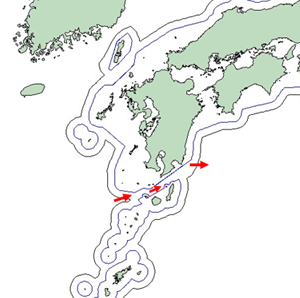 https://www.mod.go.jp/js/pdf/2026/p20260611_01.pdf |
| 6/11 |
On June 6, the JMSDF confirmed one Chinese Jiangkai II class frigate (hull number 515) and one Chinese Luyang III class destroyer (hull number 155) sailing northeast in waters 70km southeast of Okinawajima Island. From June 8 to 9, these vessels loitered in waters east of Kikaishima Island (Kagoshima Prefecture). On June 10, these vessels sailed southwest through waters between Amami Oshima Island (Kagoshima Prefecture) and Yokoatejima Island (Kagoshima Prefecture) and navigated to the East China Sea. 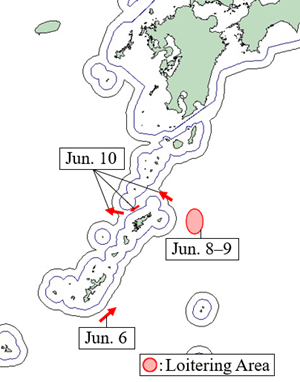 https://www.mod.go.jp/js/pdf/2026/p20260611_02.pdf |
| 6/11 |
Taiwan's coast guard condemned Beijing after two Chinese vessels intruded into the prohibited waters around Taiwan-controlled Taiping Island on June 11. The agency called the first-time intrusion into the Spratly archipelago's largest island an escalation of grey-zone harassment aimed at creating a false impression of jurisdiction. Meanwhile, Taiwan's coast guard said June 6 that a Chinese survey vessel joined a Chinese coast guard ship near Pratas Island, which is controlled by Taiwan, in the northern South China Sea. It marked the first observed instance of the two vessels coordinating to provoke Taiwan. AFP News (Le Monde)https://www.lemonde.fr/en/international/article/2026/06/11/taiwan-says-chinese-ships-entered-waters-of-disputed-south-china-sea-island_6754340_4.html |
| 6/12 |
According to U.S. officials, U.S. intelligence analysts are scrutinizing recent Chinese maritime operations near Scarborough Shoal, where Beijing has installed a "scientific structure." The officials revealed that the U.S. engaged Beijing over the structure; while the Chinese military claimed it was non-military, Chinese officials did not fully disavow its potential use by the PLA. U.S. and Philippine officials worry that the development represents another incremental step in China's history of establishing physical control over disputed features, including transforming reefs into fortified artificial islands. Last year, it was reported that the U.S. military planned a "show of force" against recent Chinese aggression near Scarborough Shoal to signal Washington's intent to push back against Beijing and defend Philippine sovereignty and fishing rights. CBS Newshttps://www.cbsnews.com/news/u-s-monitoring-chinese-activity-in-south-china-sea-around-disputed-shoal/ |
| 6/12 |
Monthly Statistics on Scrambles(May) The Japan Joint Staff released its monthly statistics on scrambles. In May, the Japan Air Self Defense Force (JASDF) conducted 59 scrambles. The most scrambles were against Chinese aircraft (49 times), followed by Russian aircraft (10 times). Japan Joint Staffhttps://www.mod.go.jp/js/pdf/2026/p20260612_05.pdf |
| 6/12 |
On June 12, the Japan Joint Staff confirmed one Chinese Y-9 intelligence gathering aircraft flying from the continent through the East China Sea toward the area south of the Danjo Islands, Nagasaki Prefecture. The aircraft flew southwest to the area off the coast of Okinawajima Island before turning back. It then flew northeast toward the area south of the Danjo Islands, changed course, and proceeded toward the continent. On the same day, the Japan Joint Staff also confirmed one Chinese TB-001 reconnaissance strike UAV flying from the East China Sea toward the area off the Danjo Islands. The UAV then turned south toward the area off Okinawajima Island, changed course, and proceeded toward the continent. In response, the JASDF scrambled fighter jets. 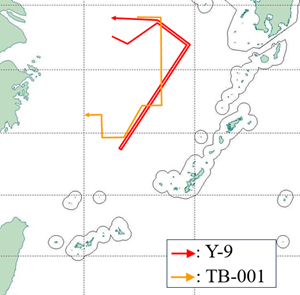 https://www.mod.go.jp/js/pdf/2026/p20260612_06.pdf |
| 6/12 |
On June 12, Japan-Thailand Foreign Ministers’ Meeting was held in Tokyo. Japan’s minister stated his commitment to strengthening the bilateral "Comprehensive and Strategic Partnership" and cooperating under the updated FOIP to enhance regional resilience and promote countries' freedom to decide for themselves. He also expressed Japan’s intent to promote cooperation across a wide range of fields, including security. Both sides exchanged views on international affairs, including regional challenges in the East and South China Seas, and reaffirmed their continued close coordination. Ministry of Foreign Affairs of Japanhttps://www.mofa.go.jp/press/release/pressite_000001_02411.html |
| 6/13 |
On June 12, Japan’s defense minister paid a courtesy call on Indonesia’s president at the president’s private residence. The two exchanged views, joined by Indonesia’s defense minister. Japan’s minister noted that strengthening Indonesia’s maritime deterrence capabilities would contribute to regional peace and stability, and underscored the need for closer maritime security cooperation. Indonesia’s president expressed strong support for these views. The two sides also agreed to explore further cooperation, including classified information sharing in the maritime domain, more efficient use of ports, and cooperation in logistics and maintenance services. Japan’s minister said that discussions under the new defense equipment transfer framework to realize the transfer of equipment, including Asagiri-class destroyers, would strengthen maritime security cooperation. Indonesia’s president expressed expectations for concrete progress in defense equipment and technology cooperation. Ministry of Defense of Japanhttps://www.mod.go.jp/en/article/2026/06/293654b38c7dfc989125230c0b7f804456ae397a.html |
| 6/14 |
On June 14, Japan-UK Summit Meeting was held in London. The UK prime minister expressed satisfaction with close defense and defense industry cooperation with Japan and reaffirmed joint commitments to GCAP. Japan’s prime minister said Japan and the UK are like-minded partners with shared strategic recognition of Indo-Pacific and Euro-Atlantic security, advancing security cooperation at a “quasi-allies” level. The two leaders agreed to accelerate the Global Combat Air Programme (GCAP) and expected further strengthening of defense and defense industry cooperation. They also exchanged views on the Indo-Pacific, including China, and confirmed continued close coordination. Ministry of Foreign Affairs of Japanhttps://www.mofa.go.jp/erp/erp_1/gb/pageite_000001_00004.html |
Newsletter Registration
What is happening in East Asian Maritime Security? The Research Institute for Peace and Security (RIPS) publishes the biweekly newsletter, “East Asian Maritime Security (EAMS)” and updates the information on maritime security relevant to East Asia and Japan's territory.