



Vol.40. February 27. 2026
What is happening in East Asian Maritime Security? The Research Institute for Peace and Security (RIPS) publishes the biweekly newsletter, the information on maritime security relevant to East Asia and Japan's territory.
Monthly Column
China’s Radar Illumination and Information Releases as a Hybrid Warfare Operation
by Futoshi Tsubokubo,
Senior Research Fellow, Nakasone Peace Institute
1. Introduction
On December 7, 2025, Japan’s Ministry of Defense released a statement regarding an incident in which a People’s Liberation Army (PLA) J-15 fighter aircraft, which had launched from the PLA Navy aircraft carrier “Liaoning,” illuminated a Japan Self-Defense Force (JSDF) fighter aircraft with its radar in the high seas airspace southeast of Okinawa Island on December 6[1]. According to the statement, the radar illumination was conducted intermittently on two occasions for a total duration of more than thirty minutes, which was a dangerous act that exceeded the range necessary for a safe flight of aircraft, and the Japanese Government made a strong protest against the extremely dangerous act and strongly urged the Government of China to ensure that similar actions do not recur.
China’s reaction was swift. On the same day, a Chinese Foreign Ministry spokesperson urged the Japanese side to stop its dangerous moves, which, according to China, caused maritime and air security risks and harassed China’s routine military exercises and training activities[2]. The spokesperson also insisted that Japan was deliberately making a false accusation against China to raise tension and mislead the international community with disinformation and political manipulation. Further, on December 9, just two days after Japan’s statement, a Chinese social media account affiliated with China Central Television (CCTV), China’s state broadcaster, released an alleged audio recording of radio communications in which a PLA vessel notified a JSDF ship of a training area[3]. Following the release of the radio recording, Chinese media reported details of the incident in their own accounts. For example, Global Times, a media outlet affiliated with the Chinese Communist Party, released its own account of the two sides’ aircraft maneuvers, asserting that the JSDF fighter jet had intentionally disrupted China’s routine military training despite China’s prior notification of the training area[4]. It further claimed that Japan was maliciously hyping the so‑called “China threatens regional security” narrative. Meanwhile, Japan’s Defense Minister Shinjiro Koizumi rejected the Chinese claim that it had issued advance warnings, noting that no proper notification—such as a Notice to Airmen (NOTAM)—had been provided. He also explained that airborne radar systems on fighter aircraft serve not only search functions but also fire-control purposes; therefore, conducting such intermittent illumination constitutes a dangerous act[5].
It is not the first time that the PLA has conducted radar illumination against JSDF maritime and air assets. In January 2013, a PLA naval vessel directed fire-control radar at a JSDF ship and a rotary-wing aircraft[6]. In both the previous incident and the present case, the PLA forces are suspected of intentionally illuminating the JSDF assets with radar. However, what distinguishes the current incident is that China proactively released information, including the alleged audio recording.
What accounts for the difference between the past and present cases? What objectives did China seek to achieve by releasing this information? This article addresses these questions through the lens of hybrid warfare, including disinformation operations.
2. Hybrid warfare — a blend of military and non‑military means
Hybrid warfare refers to the use of a blend of military and non-military means to achieve strategic objectives. For example, the North Atlantic Treaty Organization (NATO) describes hybrid threats as a combination of military and non-military, as well as covert and overt, means, including disinformation, cyberattacks, economic pressure, the deployment of irregular armed groups, and the use of regular forces[7]. Hybrid warfare is characterized by the pursuit of strategic goals without resorting to full-scale military operations, which have traditionally been considered essential in most cases.
Moreover, a distinctive feature of hybrid warfare is that its targets are not limited to the physical domain; they also encompass domestic and international information spaces, as well as the cognitive domain of populations influenced by those information flows. Accordingly, in hybrid warfare, battlespace extends from the physical domain to the information and cognitive domains, where not only traditional land, maritime, and air superiority but also information superiority is sought. By its very nature, hybrid warfare is therefore highly complex, employing a wide range of instruments and blurring the boundaries between peacetime and wartime.
To address the complexity of hybrid warfare, various efforts have been made. One of them is the hybrid warfare conceptual model developed by the European Centre of Excellence for Countering Hybrid Threats (Hybrid CoE)[8]. The conceptual model—composed of four pillars: actors and their strategic objectives, the tools applied by them, the domains they targeted, and the phases of activity—provides a framework for understanding the complexity of hybrid threats. The conceptual model illustrates forty hybrid warfare tools and thirteen targeted domains. These tools encompass a wide range of kinetic and non kinetic means, including conventional and sub conventional military operations, military exercises, and disinformation campaigns and propaganda. The targeted domains consist of various societal elements, such as diplomacy, politics, and information. The following section examines this case with reference to the analytical frameworks of hybrid warfare presented in the existing literature.
3. An analysis of the incident through the lens of hybrid warfare
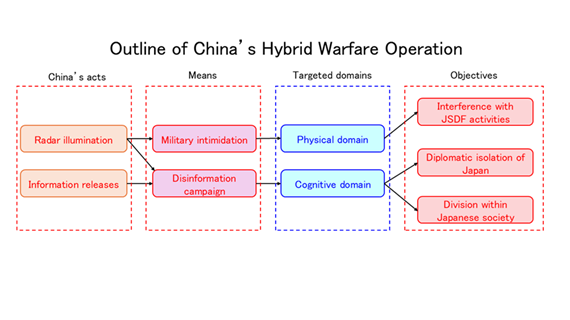
This section analyzes China’s radar illumination incident and its subsequent information releases through the lens of hybrid warfare. More specifically, it examines the means employed and the domains targeted in order to clarify China’s objectives.
With respect to the means employed, China used two main instruments: military intimidation and a disinformation campaign. First, China used military platforms deployed for the exercise on the high seas southeast of Okinawa—specifically, the J-15 fighter jet that illuminated the JSDF aircraft with its radar. This act constituted military intimidation by China’s naval and air forces. Second, while asserting that the Japanese fighter jet had entered the training area despite China’s prior notice, China also claimed that Japan was spreading the narrative that China poses a threat to regional security. China’s subsequent statements and media releases constituted a coordinated disinformation campaign.
In terms of the targeted domains, China conducted simultaneous actions across the physical and cognitive domains. In the physical domain, it carried out military intimidation by illuminating the JSDF fighter jet with its radar, thereby interfering with Japan’s routine warning and surveillance activities. In the cognitive domain, it targeted both international and domestic information spaces through its disinformation campaign. China sought to create the impression that Japan was escalating regional tensions by claiming that the JSDF fighter jet had deliberately approached in a dangerous manner despite China’s prior notice and had interfered with its military exercises. By disseminating this narrative in the international information space, China attempted to weaken Japan’s ties with its ally and like-minded countries and to isolate Japan diplomatically. Furthermore, China also appears to have sought to influence the cognitive domain of the Japanese public through its disinformation campaign. Specifically, it appears to have aimed to mislead the Japanese public into believing—incorrectly—that the Japanese government and the JSDF were engaging in dangerous actions that would worsen Japan–China relations, thereby sowing division between the government, the JSDF, and the public.
In sum, the radar illumination incident and China’s subsequent information releases constitute a hybrid warfare operation, employing both military intimidation and a disinformation campaign to target the physical and cognitive domains. The objectives of this hybrid warfare operation appear to have been to interfere with JSDF activities, diplomatically isolate Japan, and sow division between the Japanese government, the JSDF, and the Japanese public.
In addition, China may have taken advantage of a preexisting situation in which tensions between Japan and China had already intensified. China reacted sharply to Prime Minister Sanae Takaichi’s remarks concerning the possibility of a survival-threatening situation related to a Taiwan contingency on November 7—approximately one month before the radar illumination incident. For example, China's Consul General in Osaka, Xue Jian, posted a comment on social media stating that "the dirty neck that sticks itself in must be cut off." On November 13, a Chinese Defense Ministry spokesperson warned Japan of a "crushing" military defeat if it uses force to intervene over Taiwan[9]. China thus appears to have exploited the heightened tensions that it had itself unilaterally escalated.
4. Conclusion
In conclusion, the said Chinese activities constitute a hybrid warfare operation. The means included military intimidation and a disinformation campaign, encompassing both kinetic and non‑kinetic instruments. The targeted domains were the physical and cognitive domains. The objectives of the operation were to disrupt the JSDF’s routine warning and surveillance activities, to diplomatically isolate Japan, and to sow division between the Japanese government, the JSDF, and the Japanese public.
The radar illumination by the PLA J 15 fighter jet against the JSDF aircraft attracted significant attention because it was extremely dangerous and deviated from established international practice. However, the radar illumination incident should not be viewed in isolation. Rather, it formed part of a more complex hybrid warfare operation and should be understood in conjunction with China’s subsequent information releases, as well as the heightened tensions between Japan and China at the time.
China’s prompt and well organized response to the incident suggests that it executed this hybrid operation deliberately and with prior planning. The National Security Strategy of Japan states that “it is highly likely that hybrid warfare, combining military and non-military means to achieve military objectives such as information warfare which utilizes the spread of disinformation prior to an armed attack, will be conducted in an even more sophisticated form in the time ahead[10].” The radar illumination incident and China’s subsequent information releases can be assessed as a concrete example of such sophisticated hybrid warfare operations combined with information warfare.
While this hybrid operation warrants careful assessment from a longer-term perspective, it has thus far had only limited effects on both domestic and international public opinion. For example, in a statement released on December 12, the Philippines’ Department of National Defense characterized the radar illumination by the Chinese fighter jet as an unsafe and escalatory action[11]. This is primarily because Japan’s Ministry of Defense provided timely and appropriate information, explaining that the radar illumination constituted a dangerous act in light of the characteristics of airborne radar systems on fighter aircraft and that no proper prior notification of the training area, including a NOTAM, had been issued.
Going forward, China is expected to continue employing hybrid warfare against Japan by integrating information warfare into its broader strategy. It likely seeks not only to exert pressure —such as military intimidation—in the physical domain, but also to influence domestic and international information space and the cognitive domain. Therefore, the Japanese government and the JSDF should strengthen their posture and capabilities to achieve information superiority, in addition to maintaining superiority in the traditional physical domains of land, maritime, and air. Furthermore, given that the information space has become globally integrated as a result of advances in information technology and the expansion of communication networks, Japan should enhance cooperation in countering hybrid warfare including disinformation operations with the United States—its ally—as well as with like-minded countries that share universal values, including freedom, democracy, respect for fundamental human rights, and the rule of law.
Notes
[1] Japan Ministry of Defense, “Radar Illumination of JASDF Aircraft by Chinese Military Aircraft,” December 7, 2025,
https://www.mod.go.jp/en/article/2025/12/90c1af84b1ccce0dc35f51c768601d6921647ce5.html.
[2] Ministry of Foreign Affairs, People’s Republic of China, “Foreign Ministry Spokesperson’s Remarks on Japan’s Accusation of Chinese Naval Carrier-Based Aircraft Conducting “Radar Illumination” on Japanese SDF Fighter Jets,” December 7, 2025,
https://www.fmprc.gov.cn/eng/xw/fyrbt/202512/t20251207_11768175.html.
[3] “On-site audio proves Japanese maritime SDF vessel received notifications from Chinese Liaoning carrier formation: yuyuantantian,” Global Times, December 9, 2025,
https://www.globaltimes.cn/page/202512/1350133.shtml.
[4] Ibid.
[5] Japan Ministry of Defense, “Remarks by Defense Minister against China’s Claims on the Radar Incident against Japan Air Self-Defense Force Aircraft by Chinese Military Aircraft on Dec. 6th (Press Conference on Dec. 9th, 2025),” December 10, 2025,
https://www.mod.go.jp/en/article/2025/12/a405aec2bc5d9b9b37ebcbb1c342446fc54a6375.html.
[6] Japan Ministry of Defense, Defense of Japan 2025, 2025, p. 69.
[7] The North Atlantic Treaty Organization, “Countering Hybrid Threats,” January 29, 2026,
https://www.nato.int/en/what-we-do/deterrence-and-defence/countering-hybrid-threats.
[8] The European Centre of Excellence for Countering Hybrid Threats, “The landscape of Hybrid Threats: A conceptual model,” February 2021,
https://www.hybridcoe.fi/publications/the-landscape-of-hybrid-threats-a-conceptual-model/.
[9] “China warns Japan of 'crushing' defeat, tells Chinese citizens to shun visits,” Reuters, November 15, 2025.
[10] Cabinet Secretariat, National Security Strategy of Japan (Provisional Translation), December, 2022, p. 6,
https://www.cas.go.jp/jp/siryou/221216anzenhoshou/nss-e.pdf.
[11] “DND hits China's radar lock on Japanese aircraft: 'Unsafe, escalatory, reckless',” Manila Bulletin, December 13, 2025.
Views expressed or implied in this article are solely those of the author. They must not be construed as representing the views and positions of RIPS or any other organizations.
Statistical Data and Analysis (as of February 27)
In the latter half of this month, Japan’s foreign and defense ministers visited Germany for the Munich Security Conference. The foreign minister attended the G7 Foreign Ministers’ Meeting and met with the NATO secretary-general and the foreign ministers of the United States and Germany, reaffirming the importance of international coordination. He also joined a panel discussion, stressing the need to uphold a free and open international order based on the rule of law. The defense minister met with the NATO secretary-general and the defense ministers of the United Kingdom, New Zealand, Italy, and Canada, emphasizing that Euro-Atlantic and Indo- Pacific security are inseparable and pledging close cooperation. He also delivered a speech on Japan’s security policy and participated in a dialogue on the main stage of the Munich Security Conference.
Japan’s Ministry of Defense also held the Japan–Pacific Islands Defense Dialogue (JPIDD), inviting Pacific Island countries, regional partner countries, and ASEAN countries. Through this meeting of defense ministers, discussions deepened mutual trust and confirmed stronger cooperation in addressing shared challenges.
Separately, plans were announced to increase the deployment of the United States’ advanced missile systems in the Philippines.
[Statistical Data as of February 27]
The Japan Coast Guard (JCG) daily updates the statistical data on the number of China Coast Guard vessels entering in the contiguous zone around the Senkaku Islands and intruding into Japanese territorial waters. The below is from the website of the JCG.
https://www.kaiho.mlit.go.jp/mission/senkaku/senkaku.html
| Feb. | Contiguous zone |
Territorial Waters |
Feb. | Contiguous zone |
Territorial Waters |
|
|---|---|---|---|---|---|---|
| 13 | 4 | 20 | 2 | |||
| 14 | 4 | 21 | 4 | |||
| 15 | 4 | 22 | 4 | |||
| 16 | 4 | 23 | 4 | |||
| 17 | 4 | 24 | 4 | |||
| 18 | 4 | 25 | 4 | |||
| 19 | 4 | 26 | 4 |
Topics
| Date | Topics |
|---|---|
| 2/13 |
Monthly Statistics on Scrambles(January) Japan Joint Staff released its monthly statistics on scrambles. In January, JASDF conducted 41 scrambles. The most scrambles are against Russian aircrafts (26 times). The others were against Chinese aircrafts (15 times). Japan Joint Staffhttps://www.mod.go.jp/js/pdf/2026/p20260213_01.pdf |
| 2/13 |
On February 13, Japan–UK defense ministerial meeting was held in Munich. The two ministers confirmed continued close cooperation across broad areas. They reaffirmed that the security of the Euro-Atlantic and Indo-Pacific regions is inseparable and pledged to oppose unilateral attempts to change the status quo by force. Ministry of Defense of Japanhttps://www.mod.go.jp/en/article/2026/02/d66ec8a7b9b761ecad771138df49e1570d6f2cd3.html |
| 2/13 |
On February 13, meeting between Japan’s defense minister and NATO secretary general was held in Munich. They reaffirmed their shared view that the security of the Euro-Atlantic and Indo-Pacific regions is inseparable. They concurred that cooperation between Japan and NATO and between NATO and IP4 (Indo-Pacific Four: Japan, Australia, New Zealand, and the Republic of Korea) is increasingly important for strengthening deterrence and should be enhanced. They exchanged views on the regional security environment and Japan-NATO cooperation and confirmed they would promote the partnership. Ministry of Defense of Japanhttps://www.mod.go.jp/en/article/2026/02/c27a164958d2c88799f2080c62ae9552cd80ae7e.html |
| 2/13 |
On February 13, Japan-New Zealand defense ministerial meeting was held in Munich. The two Ministers confirmed that they would work together to promote cooperation with NATO and European countries as a member of the IP4, based on the recognition that security of Europe-Atlantic and Indo-Pacific is inseparable. Ministry of Defense of Japanhttps://www.mod.go.jp/en/article/2026/02/f9a3ca5cf93b1a42a6e437cd84ebe7dfadd8a9f9.html |
| 2/13 |
On February 13, Japan–Italy defense ministerial meeting was held in Munich. The two ministers exchanged views on regional security issues and confirmed that they would work closely together, based on the view that security of Euro-Atlantic and Indo-Pacific is inseparable. Ministry of Defense of Japanhttps://www.mod.go.jp/en/article/2026/02/484acabef0d3a45cb1dc15a586afe37d7abfa075.htm |
| 2/13 |
On February 13, Japan–Canada defense ministerial meeting was held in Munich. The two ministers noted that, based on their shared recognition that the security of the Euro-Atlantic and Indo-Pacific regions is increasingly inseparable, strengthening cooperation with like-minded countries is becoming more important. They confirmed they would continue working closely to deepen Japan–Canada defense cooperation and exchanges and advance a Free and Open Indo-Pacific. Ministry of Defense of Japanhttps://www.mod.go.jp/en/article/2026/02/7266942cdd9786db922ea120bb7caa3bf7af325c.html |
| 2/13 |
On February 13, Japan’s defense minister delivered a speech on Japan’s security and defense policy and participated in a dialogue on the main stage of the Munich Security Conference. He noted that the international order—rule of law, freedom of navigation, and respect for sovereignty—is being tested by attempts to unilaterally change the status quo in the Indo-Pacific. He outlined key initiatives: strengthening Japan’s defense, reinforcing the Japan-U.S. Alliance, and expanding Indo-Pacific connectivity. He reaffirmed Japan’s determination to work with allies and like-minded partners and to contribute to global peace and stability through broad security cooperation. Ministry of Defense of Japanhttps://www.mod.go.jp/en/article/2026/02/5c4425b46125fb1b988856ef2185e310836423b9.html Munich Security Conference: Speech and Dialogue (Video) https://securityconference.org/en/msc-2026/agenda/event/japan-in-the-world/ |
| 2/14 |
On February 13, Japanese authorities released the captain of a Chinese fishing vessel captured in Japan's exclusive economic zone after China submitted documents guaranteeing a deposit. The vessel ignored an order to stop, and officials arrested the captain on suspicion of violating the law on sovereign fishing rights. The captain admitted not complying with the inspection. NHK Worldhttps://www3.nhk.or.jp/nhkworld/en/news/20260214_01/ |
| 2/14 |
On February 14, Japan’s foreign minister met with the NATO secretary general in Munich. The minister welcomed continued high-level exchanges and stated that, given the inseparability of Euro-Atlantic and Indo-Pacific security, cooperation between Japan and NATO and between NATO and its Indo-Pacific partners (Australia, New Zealand, and the Republic of Korea) is strategically important. He added that Japan will strengthen relations with NATO. The secretary general shared this view, expressed his desire to further develop the Japan-NATO relationship, and valued Japan’s cooperation with NATO. They exchanged views on regional issues, including the Indo-Pacific, and confirmed that Japan and NATO and NATO and its Indo-Pacific partners will continue close cooperation. Ministry of Foreign Affairs of Japanhttps://www.mofa.go.jp/erp/ep/pageite_000001_00009.html |
| 2/14 |
On February 14, the G7 foreign minister’s meeting was held in Munich. On international partnerships, India’s foreign minister joined discussions on cross-cutting threats, including maritime security. The ministers reaffirmed the importance of the G7 working closely with partners, including Global South countries. On maritime security, Japan’s minister outlined Japan’s initiatives under the Free and Open Indo-Pacific (FOIP) and emphasized cooperation among like-minded countries. Regarding regional situations, the G7 ministers discussed a wide range of areas and confirmed the importance of a coordinated response. On the Indo-Pacific, Japan’s minister explained Japan’s position on recent developments. Ministry of Foreign Affairs of Japanhttps://www.mofa.go.jp/fp/pc/pageite_000001_00013.html |
| 2/14 |
On February 14, Japan-U.S. foreign ministers’ meeting was held in Munich. Japan’s minister expressed his desire to work closely to forge a new chapter in the Japan-U.S. Alliance. They exchanged candid views on common challenges across various fields and agreed on concrete security cooperation to strengthen the Alliance’s deterrence and response capabilities. They affirmed their commitment to coordination among like-minded countries, such as Japan-U.S.-ROK, Japan-U.S.-Philippines, and Japan-Australia-India-U.S., toward a free and open Indo-Pacific, and exchanged broad views on regional affairs. U.S. secretary of state reiterated the United States’ unwavering commitment to the Japan-U.S. Alliance. Ministry of Foreign Affairs of Japanhttps://www.mofa.go.jp/na/na1/us/pageite_000001_01481.html |
| 2/14 |
On February 14, Japan-Germany foreign ministers’ meeting was held in Munich. Germany’s minister stated that deepening cooperation with Japan, a partner sharing common values, is increasingly important and expressed his desire to further deepen bilateral cooperation. In response, Japan’s minister welcomed Germany’s active engagement in the Indo-Pacific, noting this year marks the 10th anniversary of Japan’s “Free and Open Indo-Pacific” (FOIP), and stated his intention to continue close cooperation. They confirmed they will further strengthen the security foundation based on progress in bilateral security cooperation and frankly exchanged views on the situation in East Asia. They confirmed that Japan and Germany will work closely to address international challenges. Ministry of Foreign Affairs of Japanhttps://www.mofa.go.jp/erp/erp_2/de/pageite_000001_00006.html |
| 2/14 |
On February 14, Japan’s foreign minister attended a panel discussion at the Munich Security Conference in the session “Double Trouble? Europe, Asia, and Connected Security Challenges”. In the panel discussion, he noted that the security environment is undergoing the most significant changes since WWII and emphasized the need to uphold a free and open international order under the “Free and Open Indo-Pacific (FOIP).” He highlighted that Euro-Atlantic and Indo-Pacific security are inseparable and stressed the importance of cooperation with like-minded countries, including European partners, alongside the Japan-U.S. Alliance. The panelists discussed policy toward China and cooperation among allies and like-minded countries. Ministry of Foreign Affairs of Japanhttps://www.mofa.go.jp/fp/nsp/pageite_000001_00003.html Munich Security Conference: Panel Discussion (Video) https://securityconference.org/en/msc-2026/agenda/event/double-trouble-europe-the-indo-pacific-and-connected-security-challenges/ |
| 2/14 |
On February 14, Japan-Germany defense ministerial meeting was held in Munich. They welcomed close defense cooperation and exchanges between Japan and Germany across all services, sharing the view that Euro-Atlantic and Indo-Pacific security are inseparable. They confirmed they will continue to deepen Japan–Germany defense cooperation, including within the Japan-NATO framework, and promote a security environment that does not tolerate unilateral attempts to change the status quo by force. Ministry of Defense of Japanhttps://www.mod.go.jp/en/article/2026/02/724df62e4a1337bf01f35f9a2ea1899cbef41416.html |
| 2/14 |
On February 14, Japan–Australia defense ministerial meeting was held in Munich. They expressed their commitment to continue discussions to further strengthen Japan–Australia defense cooperation. They reaffirmed the importance of cooperating and taking concrete steps to strengthen multi-layered cooperative relationships for peace and stability in the Indo-Pacific, with Japan and Australia as a central pillar of coordination among like-minded countries. Ministry of Defense of Japanhttps://www.mod.go.jp/en/article/2026/02/b0bf28b047416ef0cee38ce08a002cbba40a1898.html |
| 2/14 |
On February 14, meeting between Japan’s defense minister and EU high representative for foreign affairs and security policy was held in Munich. At the meeting, they exchanged views on Japan–EU defense cooperation and the increasingly severe security environment. They confirmed they would further promote cooperation, including in maritime security, and work closely to maintain a rules-based international order and advance a Free and Open Indo-Pacific. Ministry of Defense of Japanhttps://www.mod.go.jp/j/approach/exchange/area/2026/20260214_eu-j.html |
| 2/15 |
On February 14, China’s foreign minister again criticized Japan at the Munich Security Conference over prime minister Takaichi Sanae’s remarks on a Taiwan contingency, warning of what he called a dangerous trend in Japan. He said the comments challenged China’s sovereignty and the post-World War II order, adding that China could not accept them. He also accused Japan of harboring ambitions to invade and colonize Taiwan and said the specter of militarism still lingers. China has used international forums to press its criticism. Japan’s foreign minister responded that Japan has followed a pacifist path since World War II and remains committed to global peace and prosperity, adding that China’s claims are unfounded. NHK Worldhttps://www3.nhk.or.jp/nhkworld/en/news/20260215_01/ |
| 2/15 |
Excerpt from a statement posted on the website of the Ministry of Foreign Affairs of Japan On February 14, a Chinese participant made inappropriate remarks regarding Japan’s security policies at the Munich Security Conference. In response, Japan’s Foreign Minister clarified Japan’s position at another session and lodged a stern demarche through diplomatic channels. As China’s assertions are factually incorrect and unfounded, Japan reiterates its position. Some countries have increased their military capabilities in a non-transparent manner and attempted unilateral changes to the status quo by force or coercion, which Japan opposes. Japan’s contributions to international peace and stability are widely recognized. Its efforts to strengthen defense capabilities respond to a severe security environment and are not directed at any specific country. Japan expects the Taiwan issue to be resolved peacefully through dialogue. As challenges remain, communication between Japan and China is essential, and Japan remains open to dialogue and will continue to respond calmly and appropriately. Ministry of Foreign Affairs of Japanhttps://www.mofa.go.jp/a_o/c_m1/cn/pageite_000001_01483.html |
| 2/15 |
Japan, through the Japan International Cooperation Agency, plans to aid development of a fish market in Indonesia's Natuna Islands, including a wharf, cold-storage, and ice-making facilities, with the market expected to be completed in about a year. Japan has been boosting fishery-related aid to the Natuna Islands in the southern South China Sea, likely to curb China's influence. Jiji Press Newshttps://sp.m.jiji.com/english/show/45812 |
| 2/16 |
On February 14, the Japan Maritime Self Defense Force (JMSDF) confirmed two Russian Steregushchiy class frigate (hull number 333 and 343) and one Dubna class medium seagoing tanker sailing southwest in waters 90km northeast of Tsushima Island (Nagasaki Prefecture). These vessels sailed southwest through the Tsushima Strait and navigated to the East China Sea. 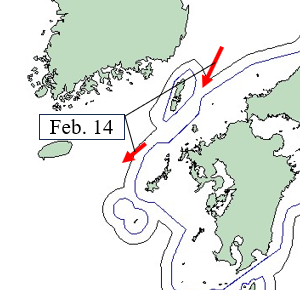 On February 16, these vessels sailed southwest through waters between Yonagunijima Island and Iriomotejima Island (both in Okinawa Prefecture) and navigated to the Pacific Ocean. 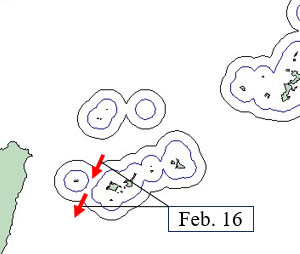 https://www.mod.go.jp/js/pdf/2026/p20260216_01.pdf |
| 2/16 |
On February 16, the Japan Joint Staff confirmed one Russian IL-20 intelligence gathering aircraft flying from the continent over the Sea of Japan. The aircraft flew to the area off the coast of Shimane Prefecture, then turned back and flew toward the continent. 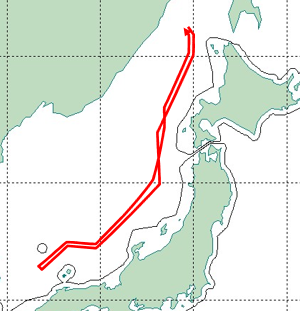 https://www.mod.go.jp/js/pdf/2026/p20260216_02.pdf |
| 2/16 |
On February 16, Japan’s chief cabinet secretary said the government is updating its vision of a free and open Indo-Pacific. Citing China’s growing influence and Russia’s invasion of Ukraine, he said Japan’s security environment is becoming increasingly challenging. He said the vision, put forward 10 years ago, needs to evolve to meet changing times. The government will add responses to challenges such as economic security and technology competition while retaining its core principles of freedom and the rule of law. Jiji Press Newshttps://sp.m.jiji.com/english/show/45803 |
| 2/17 |
On February 17, the United States and the Philippines outlined defense and security plans for this year in a joint statement, including joint military exercises, military modernization support, and increased deployments of U.S. missile and unmanned systems. They condemned what they called China’s “illegal, coercive, aggressive, and deceptive activities” in the South China Sea and reaffirmed freedom of navigation, overflight and other lawful uses of the sea. A mid-range U.S. missile system deployed in 2024, along with an anti-missile launcher deployed last year, remains in the Philippines. China has repeatedly expressed alarm over the deployment and urged the Philippines to withdraw the missile launchers, but Manila has rejected the demand. Neither side elaborated on further missile deployments, though the Philippines is considering future purchases. A Philippine official said the deployments are aimed at deterrence and are not intended to target any country. The Associated Presshttps://apnews.com/article/philippines-united-states-missile-systems-63705028db23da2c5a45ae7a46366b77 |
| 2/18 |
On February 18, Japan-EU political directors dialogue was held. Japan's senior deputy foreign minister stated that the security of the Euro-Atlantic and Indo-Pacific regions is closely linked and expressed Japan’s desire to deepen strategic cooperation with the EU across various fields. The EU’s deputy secretary general agreed, and they concurred to elevate Japan-EU relations through cooperation in political and security matters. They also exchanged views on international situations, including the Indo-Pacific, and affirmed that Japan and the EU will continue close cooperation within multilateral frameworks. Ministry of Foreign Affairs of Japanhttps://www.mofa.go.jp/press/release/pressite_000001_02091.html |
| 2/19 |
JCG personnel held a training session in Jakarta for 10 officials from Indonesia, the Philippines, and Malaysia to improve their ability to monitor suspicious vessels. Using a JCG aircraft, they demonstrated radar techniques to determine a ship’s size and location, as well as a camera system that automatically tracks objects. A JCG official said cooperation with Southeast Asian nations will help protect the rule of law at sea and ensure a free and open Indo-Pacific. NHK Worldhttps://www3.nhk.or.jp/nhkworld/en/news/20260219_24/index.html |
| 2/20 |
On February 20, Japan’s prime minister said that, despite tough Japan-Russia relations, Japan aims to resolve the territorial issue and conclude a peace treaty, according to Russia's TASS. A Kremlin spokesman, however, said relations have "been reduced to zero" due to Tokyo's "unfriendly stance," noting that there is no dialogue and that it is impossible to discuss a peace treaty under these circumstances. He added that agreements are unlikely without changing the modalities of their relations. Reutershttps://www.reuters.com/world/asia-pacific/russia-says-no-peace-dialogue-ongoing-with-japan-2026-02-20/ |
| 2/22 |
On February 22, a meeting was held between Japan’s state minister for defense and Micronesia’s secretary of justice in Tokyo. Japan’s state minister said the two countries are partners sharing values such as freedom, democracy, and the rule of law. They welcomed ongoing defense cooperation, especially on maritime security, and agreed to continue strengthening it. Ministry of Defense of Japanhttps://www.mod.go.jp/en/article/2026/02/49359981701a0f8a2ad78feec58f0bd71a61bce3.html |
| 2/22 |
On February 19, Japan and the United States held the Extended Deterrence Dialogue (EDD) in Washington, D.C. The two sides reaffirmed the U.S. commitment to Japan’s defense using all capabilities, including nuclear, and Japan’s support for U.S. operations to maintain peace, to enhance the Alliance’s deterrence. They noted that this support reinforces U.S. deterrence by denial and that U.S. nuclear posture and Japan’s defense capabilities are key to deterring regional aggression. They also discussed security challenges from Russia, China, and North Korea, the importance of the Japan-U.S. Guidelines for Extended Deterrence, strengthening the Alliance’s strategic messaging, crisis communications, coordination to support U.S. extended deterrence, and conducted a tabletop exercise. Ministry of Foreign Affairs of Japanhttps://www.mofa.go.jp/press/release/pressite_000001_02104.html |
| 2/23 |
On February 23, the Japan-UK vice foreign ministers’ meeting was held. They confirmed that they will strengthen bilateral relations in areas such as security and defense and work together to uphold a free and open international order based on the rule of law. They exchanged views on regional and bilateral issues, including the Indo-Pacific, and confirmed that Japan and the UK will further strengthen ties through bilateral, G7, and international cooperation. Ministry of Foreign Affairs of Japanhttps://www.mofa.go.jp/press/release/pressite_000001_02105.html |
| 2/23 |
On February 23, Japan- Tonga defense minister’s meeting was held in Tokyo. Japan’s defense minister stated that Japan and Tonga are partners sharing values such as freedom, democracy, and the rule of law. They confirmed progress in maritime security cooperation, including capacity-building assistance, and agreed to establish a Memorandum on Defense Cooperation to further strengthen security collaboration. Ministry of Defense of Japanhttps://www.mod.go.jp/en/article/2026/02/02680a8cd0e274196316ce29600af572d2ccec62.html |
| 2/23 |
On February 23, Japan-PNG defense minister’s meeting was held in Tokyo. Japan’s defense minister stated that Japan and PNG are partners sharing values such as freedom, democracy, and the rule of law. They exchanged views on maritime security cooperation and affirmed their commitment to further enhance it. They agreed to establish a Memorandum on Defense Cooperation to strengthen security ties. Ministry of Defense of Japanhttps://www.mod.go.jp/en/article/2026/02/97d24706792f1557f7b07e1196e4e27b8c8d70ee.html |
| 2/23 |
On February 23, Japan-Fiji defense minister’s meeting was held in Tokyo. Japan’s defense minister stated that Japan and Fiji are partners sharing values such as freedom, democracy, and the rule of law, and paid his respect to Fiji’s important role in securing peace and stability in the region. They confirmed progress in maritime security cooperation, including capacity-building assistance. They agreed to establish a Memorandum on Defense Cooperation to strengthen security ties. Ministry of Defense of Japanhttps://www.mod.go.jp/en/article/2026/02/9fd4755085868fdf8555d4e59c2bb6e9d49d6834.html |
| 2/23 |
From February 22 to 24, the Ministry of Defense of Japan held the 3rd Japan–Pacific Islands Defense Dialogue (JPIDD) in Tokyo, with its plenary session on February 23. The three Pacific Island countries with armed forces—Fiji, Papua New Guinea and Tonga—participated, along with 11 without armed forces and seven partner countries. ASEAN countries also joined as observers for the first time, bringing total participation to 28 countries and one organization. At the outset, Japan’s Defense Minister delivered a keynote address, calling for stronger bonds and connectivity and for building an autonomous and resilient region to safeguard the Pacific Ocean as an “Ocean of Peace.” In the maritime security session, Japan introduced initiatives including the Ship-rider Program, under which officers from 11 Pacific Island countries embarked on a JMSDF vessel to share maritime security knowledge, as well as joint boarding and inspection training. In response, Pacific Island countries expressed strong appreciation. Many noted that issues such as IUU (illegal, unreported and unregulated) fishing directly affect national survival but that resources and capabilities are limited, stressing the need for cooperation with regional and external partners. Ministry of Defense of Japanhttps://www.mod.go.jp/en/article/2026/02/d488029d11aabaeabaac55b615b62f32d53009cc.html Keynote Address by Japan’s defense minister https://www.mod.go.jp/en/article/2026/02/943b03d55e3e3b350e72c0a3ac7844810c2b3755.html |
| 2/24 |
The Japanese government sent a parliamentary vice minister of the Cabinet Office as its representative to the Takeshima Day ceremony on February 22, rather than a Cabinet minister as previously suggested by Prime Minister Sanae Takaichi. A senior official said the move reflected consideration for Japan–South Korea relations. Amid cooling ties with China and challenges from U.S. President Donald Trump’s administration over tariffs and defense spending, Japan aims to advance cooperation with South Korea, whose strategic importance is growing. South Korea’s Foreign Ministry protested the ceremony, but its statement was largely identical to last year’s, suggesting a measured response mindful of bilateral relations. Yomiuri Shimbun Newshttps://japannews.yomiuri.co.jp/politics/politics-government/20260224-313234/ |
| 2/24 |
On February 24, following China’s announcement prohibiting exports of dual-use items to certain Japanese companies, a Director-General of Japan’s Foreign Ministry strongly protested to China’s Deputy Chief of Mission and demanded the withdrawal of the measures, stating that they are absolutely unacceptable and deeply regrettable, as were the measures announced on January 6, which Japan has also protested as targeting only Japan and deviating significantly from international practice. Ministry of Foreign Affairs of Japanhttps://www.mofa.go.jp/press/release/pressite_000001_02110.html |
| 2/24 |
On February 24, Japan-Germany summit telephone meeting was held. The German chancellor stated that Germany values its partnership with Japan, a like-minded country in the Indo-Pacific. The Japanese prime minister stated that close coordination between the two countries as G7 members is increasingly important, and expressed hope for Germany’s continued commitment to the Indo-Pacific, noting that Euro-Atlantic and Indo-Pacific security is inseparable. They exchanged views on East Asia and other regions and confirmed that the two countries will work closely to address international challenges. Ministry of Foreign Affairs of Japanhttps://www.mofa.go.jp/erp/erp_2/de/pageite_000001_00003.html |
| 2/25 |
On February 25, Japan’s vice foreign minister held an exchange of views with the U.S. state department counselor and policy planning director. In light of the current international situation, they discussed Japan-U.S. cooperation, particularly in security, and affirmed their commitment to strengthening the Japan-U.S. Alliance and advancing a Free and Open Indo-Pacific. They also discussed a broad range of regional issues including the Indo-Pacific, and reaffirmed close coordination between the two countries. Ministry of Foreign Affairs of Japanhttps://www.mofa.go.jp/press/release/pressite_000001_02112.html |
| 2/25 |
On February 25, Japan’s foreign minister received a courtesy call from the U.S. state department counselor and policy planning director. They discussed Japan-U.S. cooperation, including security, with the counselor reiterating the United States’ commitment to the alliance and a Free and Open Indo-Pacific. They also exchanged views on regional affairs and affirmed working closely together to realize a Free and Open Indo-Pacific. Ministry of Foreign Affairs of Japanhttps://www.mofa.go.jp/press/release/pressite_000001_02113.html |
| 2/27 |
On February 24, to demonstrate their commitment to strengthening regional and international cooperation in support of a Free and Open Indo-Pacific, Japan, U.S. and the Philippines conducted a Multilateral Exercise as a Maritime Cooperative Activity. Participating units included JMSDF P-3C; U.S. Navy (USN) destroyer and P-8A; Philippine Navy (PN) and Philippine Air Force (PAF) frigate, FA-50PH, and C-208B; and Philippine Coast Guard (PCG) patrol vessel. The exercise focused on tactical operations. Japan Joint Staffhttps://www.mod.go.jp/js/pdf/2026/p20260227_01e.pdf |
| 2/27 |
On February 27, China’s military said it conducted a routine patrol in the South China Sea from February 23 to 26, accusing the Philippines of “disrupting” peace by organising joint patrols with countries outside the region. This week, the navies of the Philippines, the U.S., and Japan trained together in the South China Sea to strengthen cooperation among the allies. Reutershttps://www.reuters.com/world/china/china-conducts-patrol-south-china-sea-accuses-philippines-disrupting-peace-2026-02-27/ |
Newsletter Registration
What is happening in East Asian Maritime Security? The Research Institute for Peace and Security (RIPS) publishes the biweekly newsletter, “East Asian Maritime Security (EAMS)” and updates the information on maritime security relevant to East Asia and Japan's territory.