



Executive Summary
A growing series of aerial encounters around Japan’s Southwestern Islands has once again exposed the fragility of international norms governing military conduct, while underscoring the profound responsibility borne by major powers. These incidents should not be viewed as isolated events; rather, they constitute part of a broader pattern testing the credibility of rules-based behavior in the air and at sea.
Drawing on firsthand experience as a fighter pilot in the Japan Air Self-Defense Force during the Cold War—first flying the F-4EJ Phantom II and later the F-15 Eagle, and directly responsible for intercepting Soviet aircraft approaching Japanese airspace—this paper argues that the true measure of a great power lies not in the display of force, but in deterrence firmly grounded in restraint. History demonstrates that stability is preserved not by bravado, but by professionalism and self-control exercised at moments of maximum tension.
By examining arbitrary military operations conducted within Japan’s Air Defense Identification Zone (ADIZ), prolonged fire-control radar illumination lasting approximately thirty minutes with intermittent breaks, so-called “salami-slicing” strategies in the gray zone, and the structural challenge known as the “Tyranny of Time and Distance,” this essay integrates political philosophy, cockpit-level operational reality, strategic analysis, and national will into a single coherent perspective.
Through comparison with the political thought of ancient sages of China Laozi (老子) , it further highlights the strategic divergence evident in contemporary Chinese behavior, while positioning Japan’s current response as an expression of democratic legitimacy and proactive contribution to peace—an embodiment of national resolve dedicated to the defense of law and order.
Security as Seen from the Cockpit
The security environment in East Asia is becoming increasingly unstable, not merely in quantitative terms of force expansion by the People’s Liberation Army (PLA), but qualitatively as well. In the airspace of the East China Sea and around Japan’s Southwestern Islands, the frequency, proximity, and ambiguity of military activities have intensified, elevating the risk of accidental confrontation. Any such “flash-point” incident would inevitably carry international ramifications.
During the Cold War, the author served as a fighter pilot in the JASDF, flying the F-4 Phantom II and subsequently the F-15 Eagle on air defense missions responding to Soviet aircraft approaching Japanese territorial airspace. These missions were routine and persistently tense, yet serious escalation remained rare.
From the cockpit, security is never an abstract concept. Decisions are measured in seconds, information is invariably incomplete, and psychological stress is constant. What is required under such conditions is not bravado, but discipline; not emotion, but composure. Defending national sovereignty with firmness while simultaneously preventing accidental escalation constituted the core responsibility of air defense missions. That reality remains unchanged today.
Radar Illumination and the Risk of Accidental Conflict
Recent incidents around the Southwestern Islands starkly illustrate these dangers. Japan Air Self-Defense Force F-15 fighters were subjected to prolonged illumination by Chinese military aircraft’s fire-control radar.
In fighter operations worldwide, sustained radar lock-on is universally recognized as an extremely grave act, signaling the immediate prelude to weapons employment. Inside the cockpit, warning tones sound continuously, imposing intense psychological pressure on the pilot as decision time rapidly contracts.
When fighter aircraft approach head-on, distance closes at approximately fifteen nautical miles per minute. To explain radar illumination lasting several minutes as accidental or the result of equipment malfunction is not realistic. Such actions are deliberate and sharply increase the risk of miscalculation.
That these incidents did not escalate into collision or weapons use was not the result of inherent stability. It was due solely to the exceptional professionalism, restraint, and calm judgment of Japan Air Self-Defense Force pilots and intercept controllers operating under extreme conditions.
ADIZ Operations and Strategic Intent
The PLA operations associated with these incidents were conducted over international waters, yet within Japan’s ADIZ, in close proximity to the Southwestern Islands and east of the First Island Chain.
The designation of airspace as international does not confer unlimited freedom of military action. Operations conducted within another state’s ADIZ— particularly in geographically sensitive areas—carry unmistakable strategic significance.
The choice of location and timing suggests not routine activity, but an intent to apply sustained pressure on Japan’s air defense posture and to normalize an expanded military presence through incremental faits accomplis.
China’s Salami-Slicing and Gray-Zone Strategy
These actions are consistent with so-called “salami-slicing” or gray-zone strategies—approaches designed to alter the status quo incrementally through small, ambiguous actions deliberately kept below the threshold of armed conflict.
While individual actions may appear manageable in isolation, such operations are inherently dangerous in the aerial domain. The defending side is repeatedly compelled to absorb risk, and over time both human and material limits are revealed. Employing air power in grey-zone contests carries a significant risk of leading to unintended incidents or accidental escalation.
The Primary Challenge: Preventing Faits Accomplis
For the Japan–U.S. alliance, the greatest danger in the East China Sea is not deliberate full-scale war. It is the accumulation of willful faits accomplis before alliance decision-making mechanisms can fully engage.
This risk is structurally amplified by the “Tyranny of Time and Distance.” The geographically proximate actor can respond immediately, while the alliance requires time for consultation, political decision-making, and force deployment. Gray-zone strategies exploit this asymmetry, advancing the situation to a point at which resistance becomes politically and militarily difficult.
Air and maritime activities around the Southwestern Islands are therefore not mere provocations. They are attempts to compress time, weaponize distance, and normalize military presence.
Overcoming Time and Distance: A Japan–U.S. Strategy
Preventing faits accomplis requires more than retaliation-based deterrence. What is needed is deterrence by denial, jointly implemented by Japan and the United States in a visible and sustained manner.
First, decision-making authority must be delegated to lower levels. Excessively centralized decision-making slows responses during the transition from peacetime to crisis and risks ceding the initiative to an adversary. Front-line commanders must be empowered to act rapidly under pre-established rules of engagement and clearly delegated authorities. At the same time, integrated, cross-domain command-and-control relationships must be established in peacetime to preserve speed and tempo.
Second, sustained presence is essential. Not episodic demonstrations following crises, but continuous and lawful peacetime operations prevent the emergence of temporal vacuums. Persistent shared-base operations and in-flight training among the JASDF, U.S. Air Force, U.S.Navy, and U.S. Marine Corps combat air forces ensure responsive, credible deterrence and, if necessary, decisive localized engagements.
Third, integration of sensors, command, and response capabilities is critical. By linking Japanese and U.S. C4ISR(Command, Control, Communication, Computer, Intelligence, Surveillance, Reconnaissance) and response capabilities into a kill web, the alliance shortens the OODA loop(Observe, Orient, Decide, Act loop) and neutralizes advantages derived from ambiguity.
Fourth, political will must be clearly articulated at the alliance level. Hesitation or delayed resolve in the U.S.–Japan Alliance creates opportunities for adversaries to pursue faits accomplis. Consistent, calm, and visibly resolute responses by Japan—reinforced by sustained and credible U.S. engagement—directly undermine this assumption.
Fifth, Japan and the United States must further strengthen strategic cooperation with like-minded partners. Deeper coordination with countries that uphold international law and democratic values enhances collective deterrence and reduces opportunities for unilateral coercion.
China’s Laozi’s Thought and Strategic Divergence
The Chinese philosopher Laozi taught that “a great state is like the lower reaches of a great river… it is the great power that should first humble itself.” A true great power stabilizes order not through intimidation, but through restraint.
Measured against this philosophy, the habitual application of pressure evident in contemporary Chinese behavior represents a clear strategic divergence. Under the Xi Jinping administration, the emphasis on active assertion and the normalization of pressure across military, political, and informational domains stand in stark contrast to Laozi’s vision of great-power conduct.
When measured against the deep wisdom of China’s ancient sages, modern China can only be described as having strayed far from those principles.
Japan’s Response: Legitimacy and Proactive Contribution to Peace
In this demanding strategic environment, Japan has deliberately refrained from emotional confrontation and instead anchored its response in democratic legitimacy, the rule of law, and close alliance coordination. Japan seeks not short-term advantage through intimidation or retaliation, but calm, responsible deterrence that contributes to long-term international stability.
The steady strengthening of deterrent capabilities must be understood in this context. The resolve demonstrated by the Takaichi administration to enhance national defense is not intended to display superiority, but to prevent miscalculation and avert conflict before it occurs. Japan chooses to possess strength precisely in order not to use it.
This approach gives concrete expression to Japan’s long-standing commitment to a “Proactive Contribution to Peace,” translating principle into practice. By reconciling restraint with resolve, deterrence with dialogue, and alliance solidarity with respect for law and order, Japan offers a model of responsible statecraft in an era of uncertainty.
Japan will continue to act with quiet, unwavering determination as a nation that rejects attempts to alter the status quo by force, accepts responsibility for sustaining regional and global order, and stands alongside those who believe that peace is preserved not by impulse, but by discipline and foresight.
Peace is not preserved by aspiration alone.
It becomes sustainable only through deterrence anchored in law and restraint.
Japan remains committed to bearing that responsibility—not in words, but through action.
It goes without saying that Japan itself must possess the strong will and resolve to defend its own country—this is the fundamental prerequisite for everything.
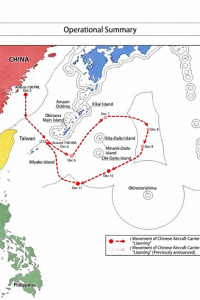
Supplementary figure: track chart of recent routes of the Liaoning and other vessels in
the vicinity of the Nansei Islands (based on data released by the Japan Joint Staff)
This paper is accompanied by a flight track diagram illustrating the trajectories, relative positions, and temporal sequence of the aircraft involved in the recent air encounter near Japan’s southwestern islands. This track diagram was prepared based on public information released by the Joint Staff Office, Ministry of Defense, Japan.
The diagram is provided for reference purposes to assist in understanding the geographic proximity, operational context, and escalation risk associated with the incident, including its occurrence within Japan’s Air Defense Identification Zone (ADIZ).
It is inferred that several formations of F-15 fighter aircraft tasked with airspace intrusion response missions calmly and consistently continued surveillance and monitoring operations in response to Liaoning’s activities, in accordance with international norms, in order to defend Japan’s airspace.
Toshimichi Nagaiwa is a retired Lieutenant General of the Japan Air Self-Defense Force and former Commander of the Air Support Command. A former fighter pilot, he flew the F-4EJ Phantom II and F-15 Eagle on air defense missions during the Cold War.