



1. Introduction
On December 7, 2025, Japan’s Ministry of Defense released a statement regarding an incident in which a People’s Liberation Army (PLA) J-15 fighter aircraft, which had launched from the PLA Navy aircraft carrier “Liaoning,” illuminated a Japan Self-Defense Force (JSDF) fighter aircraft with its radar in the high seas airspace southeast of Okinawa Island on December 6[1]. According to the statement, the radar illumination was conducted intermittently on two occasions for a total duration of more than thirty minutes, which was a dangerous act that exceeded the range necessary for a safe flight of aircraft, and the Japanese Government made a strong protest against the extremely dangerous act and strongly urged the Government of China to ensure that similar actions do not recur.
China’s reaction was swift. On the same day, a Chinese Foreign Ministry spokesperson urged the Japanese side to stop its dangerous moves, which, according to China, caused maritime and air security risks and harassed China’s routine military exercises and training activities[2]. The spokesperson also insisted that Japan was deliberately making a false accusation against China to raise tension and mislead the international community with disinformation and political manipulation. Further, on December 9, just two days after Japan’s statement, a Chinese social media account affiliated with China Central Television (CCTV), China’s state broadcaster, released an alleged audio recording of radio communications in which a PLA vessel notified a JSDF ship of a training area[3]. Following the release of the radio recording, Chinese media reported details of the incident in their own accounts. For example, Global Times, a media outlet affiliated with the Chinese Communist Party, released its own account of the two sides’ aircraft maneuvers, asserting that the JSDF fighter jet had intentionally disrupted China’s routine military training despite China’s prior notification of the training area[4]. It further claimed that Japan was maliciously hyping the so‑called “China threatens regional security” narrative. Meanwhile, Japan’s Defense Minister Shinjiro Koizumi rejected the Chinese claim that it had issued advance warnings, noting that no proper notification—such as a Notice to Airmen (NOTAM)—had been provided. He also explained that airborne radar systems on fighter aircraft serve not only search functions but also fire-control purposes; therefore, conducting such intermittent illumination constitutes a dangerous act[5].
It is not the first time that the PLA has conducted radar illumination against JSDF maritime and air assets. In January 2013, a PLA naval vessel directed fire-control radar at a JSDF ship and a rotary-wing aircraft[6]. In both the previous incident and the present case, the PLA forces are suspected of intentionally illuminating the JSDF assets with radar. However, what distinguishes the current incident is that China proactively released information, including the alleged audio recording.
What accounts for the difference between the past and present cases? What objectives did China seek to achieve by releasing this information? This article addresses these questions through the lens of hybrid warfare, including disinformation operations.
2. Hybrid warfare — a blend of military and non‑military means
Hybrid warfare refers to the use of a blend of military and non-military means to achieve strategic objectives. For example, the North Atlantic Treaty Organization (NATO) describes hybrid threats as a combination of military and non-military, as well as covert and overt, means, including disinformation, cyberattacks, economic pressure, the deployment of irregular armed groups, and the use of regular forces[7]. Hybrid warfare is characterized by the pursuit of strategic goals without resorting to full-scale military operations, which have traditionally been considered essential in most cases.
Moreover, a distinctive feature of hybrid warfare is that its targets are not limited to the physical domain; they also encompass domestic and international information spaces, as well as the cognitive domain of populations influenced by those information flows. Accordingly, in hybrid warfare, battlespace extends from the physical domain to the information and cognitive domains, where not only traditional land, maritime, and air superiority but also information superiority is sought. By its very nature, hybrid warfare is therefore highly complex, employing a wide range of instruments and blurring the boundaries between peacetime and wartime.
To address the complexity of hybrid warfare, various efforts have been made. One of them is the hybrid warfare conceptual model developed by the European Centre of Excellence for Countering Hybrid Threats (Hybrid CoE)[8]. The conceptual model—composed of four pillars: actors and their strategic objectives, the tools applied by them, the domains they targeted, and the phases of activity—provides a framework for understanding the complexity of hybrid threats. The conceptual model illustrates forty hybrid warfare tools and thirteen targeted domains. These tools encompass a wide range of kinetic and non kinetic means, including conventional and sub conventional military operations, military exercises, and disinformation campaigns and propaganda. The targeted domains consist of various societal elements, such as diplomacy, politics, and information. The following section examines this case with reference to the analytical frameworks of hybrid warfare presented in the existing literature.
3. An analysis of the incident through the lens of hybrid warfare
This section analyzes China’s radar illumination incident and its subsequent information releases through the lens of hybrid warfare. More specifically, it examines the means employed and the domains targeted in order to clarify China’s objectives.
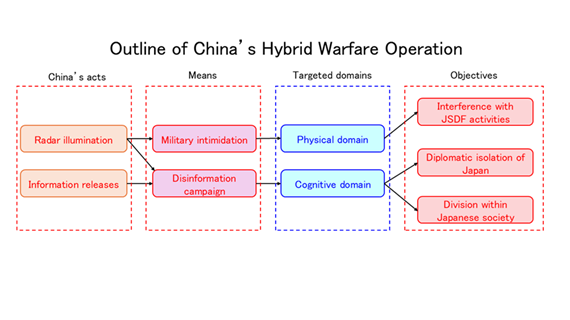
With respect to the means employed, China used two main instruments: military intimidation and a disinformation campaign. First, China used military platforms deployed for the exercise on the high seas southeast of Okinawa—specifically, the J-15 fighter jet that illuminated the JSDF aircraft with its radar. This act constituted military intimidation by China’s naval and air forces. Second, while asserting that the Japanese fighter jet had entered the training area despite China’s prior notice, China also claimed that Japan was spreading the narrative that China poses a threat to regional security. China’s subsequent statements and media releases constituted a coordinated disinformation campaign.
In terms of the targeted domains, China conducted simultaneous actions across the physical and cognitive domains. In the physical domain, it carried out military intimidation by illuminating the JSDF fighter jet with its radar, thereby interfering with Japan’s routine warning and surveillance activities. In the cognitive domain, it targeted both international and domestic information spaces through its disinformation campaign. China sought to create the impression that Japan was escalating regional tensions by claiming that the JSDF fighter jet had deliberately approached in a dangerous manner despite China’s prior notice and had interfered with its military exercises. By disseminating this narrative in the international information space, China attempted to weaken Japan’s ties with its ally and like-minded countries and to isolate Japan diplomatically. Furthermore, China also appears to have sought to influence the cognitive domain of the Japanese public through its disinformation campaign. Specifically, it appears to have aimed to mislead the Japanese public into believing—incorrectly—that the Japanese government and the JSDF were engaging in dangerous actions that would worsen Japan–China relations, thereby sowing division between the government, the JSDF, and the public.
In sum, the radar illumination incident and China’s subsequent information releases constitute a hybrid warfare operation, employing both military intimidation and a disinformation campaign to target the physical and cognitive domains. The objectives of this hybrid warfare operation appear to have been to interfere with JSDF activities, diplomatically isolate Japan, and sow division between the Japanese government, the JSDF, and the Japanese public.
In addition, China may have taken advantage of a preexisting situation in which tensions between Japan and China had already intensified. China reacted sharply to Prime Minister Sanae Takaichi’s remarks concerning the possibility of a survival-threatening situation related to a Taiwan contingency on November 7—approximately one month before the radar illumination incident. For example, China's Consul General in Osaka, Xue Jian, posted a comment on social media stating that "the dirty neck that sticks itself in must be cut off." On November 13, a Chinese Defense Ministry spokesperson warned Japan of a "crushing" military defeat if it uses force to intervene over Taiwan[9]. China thus appears to have exploited the heightened tensions that it had itself unilaterally escalated.
4. Conclusion
In conclusion, the said Chinese activities constitute a hybrid warfare operation. The means included military intimidation and a disinformation campaign, encompassing both kinetic and non‑kinetic instruments. The targeted domains were the physical and cognitive domains. The objectives of the operation were to disrupt the JSDF’s routine warning and surveillance activities, to diplomatically isolate Japan, and to sow division between the Japanese government, the JSDF, and the Japanese public.
The radar illumination by the PLA J 15 fighter jet against the JSDF aircraft attracted significant attention because it was extremely dangerous and deviated from established international practice. However, the radar illumination incident should not be viewed in isolation. Rather, it formed part of a more complex hybrid warfare operation and should be understood in conjunction with China’s subsequent information releases, as well as the heightened tensions between Japan and China at the time.
China’s prompt and well organized response to the incident suggests that it executed this hybrid operation deliberately and with prior planning. The National Security Strategy of Japan states that “it is highly likely that hybrid warfare, combining military and non-military means to achieve military objectives such as information warfare which utilizes the spread of disinformation prior to an armed attack, will be conducted in an even more sophisticated form in the time ahead[10].” The radar illumination incident and China’s subsequent information releases can be assessed as a concrete example of such sophisticated hybrid warfare operations combined with information warfare.
While this hybrid operation warrants careful assessment from a longer-term perspective, it has thus far had only limited effects on both domestic and international public opinion. For example, in a statement released on December 12, the Philippines’ Department of National Defense characterized the radar illumination by the Chinese fighter jet as an unsafe and escalatory action[11]. This is primarily because Japan’s Ministry of Defense provided timely and appropriate information, explaining that the radar illumination constituted a dangerous act in light of the characteristics of airborne radar systems on fighter aircraft and that no proper prior notification of the training area, including a NOTAM, had been issued.
Going forward, China is expected to continue employing hybrid warfare against Japan by integrating information warfare into its broader strategy. It likely seeks not only to exert pressure —such as military intimidation—in the physical domain, but also to influence domestic and international information space and the cognitive domain. Therefore, the Japanese government and the JSDF should strengthen their posture and capabilities to achieve information superiority, in addition to maintaining superiority in the traditional physical domains of land, maritime, and air. Furthermore, given that the information space has become globally integrated as a result of advances in information technology and the expansion of communication networks, Japan should enhance cooperation in countering hybrid warfare including disinformation operations with the United States—its ally—as well as with like-minded countries that share universal values, including freedom, democracy, respect for fundamental human rights, and the rule of law.
Notes
[1] Japan Ministry of Defense, “Radar Illumination of JASDF Aircraft by Chinese Military Aircraft,” December 7, 2025,
https://www.mod.go.jp/en/article/2025/12/90c1af84b1ccce0dc35f51c768601d6921647ce5.html.
[2] Ministry of Foreign Affairs, People’s Republic of China, “Foreign Ministry Spokesperson’s Remarks on Japan’s Accusation of Chinese Naval Carrier-Based Aircraft Conducting “Radar Illumination” on Japanese SDF Fighter Jets,” December 7, 2025,
https://www.fmprc.gov.cn/eng/xw/fyrbt/202512/t20251207_11768175.html.
[3] “On-site audio proves Japanese maritime SDF vessel received notifications from Chinese Liaoning carrier formation: yuyuantantian,” Global Times, December 9, 2025,
https://www.globaltimes.cn/page/202512/1350133.shtml.
[4] Ibid.
[5] Japan Ministry of Defense, “Remarks by Defense Minister against China’s Claims on the Radar Incident against Japan Air Self-Defense Force Aircraft by Chinese Military Aircraft on Dec. 6th (Press Conference on Dec. 9th, 2025),” December 10, 2025,
https://www.mod.go.jp/en/article/2025/12/a405aec2bc5d9b9b37ebcbb1c342446fc54a6375.html.
[6] Japan Ministry of Defense, Defense of Japan 2025, 2025, p. 69.
[7] The North Atlantic Treaty Organization, “Countering Hybrid Threats,” January 29, 2026,
https://www.nato.int/en/what-we-do/deterrence-and-defence/countering-hybrid-threats.
[8] The European Centre of Excellence for Countering Hybrid Threats, “The landscape of Hybrid Threats: A conceptual model,” February 2021,
https://www.hybridcoe.fi/publications/the-landscape-of-hybrid-threats-a-conceptual-model/.
[9] “China warns Japan of 'crushing' defeat, tells Chinese citizens to shun visits,” Reuters, November 15, 2025.
[10] Cabinet Secretariat, National Security Strategy of Japan (Provisional Translation), December, 2022, p. 6,
https://www.cas.go.jp/jp/siryou/221216anzenhoshou/nss-e.pdf.
[11] “DND hits China's radar lock on Japanese aircraft: 'Unsafe, escalatory, reckless',” Manila Bulletin, December 13, 2025.
Views expressed or implied in this article are solely those of the author. They must not be construed as representing the views and positions of RIPS or any other organizations.